Featured Articles
Stopping HIV: Glycopeptide opens the envelope
Functional Glycomics (08 October 2009) | doi:10.1038/fg.2009.31Standfirst
A new glycoconjugate, linking a CD4-mimetic peptide with a heparan sulfate oligosaccharide, binds cooperatively to the HIV envelope and neutralizes three virus strains.
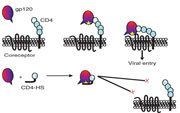
HIV entry and principle of inhibition by 'CD4-HS'. For full figure and legend see Nat. Chem. Bio. 5, 743–748 (2009) doi:10.1038/nchembio.207
Blocking viral entry is a promising approach in the fight against HIV. Entry begins when the envelope glycoprotein gp120 binds to its primary host cell receptor, CD4, and undergoes a conformational change that exposes a second binding site. This CD4-induced site can bind to several cell surface molecules, including the CCR5 or CXCR4 coreceptors and the polysaccharide heparan sulfate (HS), but its cryptic nature makes it a difficult pharmacological target. Now, Lortat-Jacob and colleagues have synthesized a new HIV-1 inhibitor by linking a CD4-mimetic peptide to a HS dodecasaccharide. They report in Nature Chemical Biology that their glycoconjugate simultaneously targets the CD4 and coreceptor binding sites, which results in a low nanomolar affinity for gp120, and has antiviral activity against three HIV-1 strains.
Despite the availability of numerous drugs for the treatment of HIV, none are yet able to eradicate the virus, and many produce adverse side effects. Furthermore, the divergent tropisms of different HIV strains make some resistant to specific inhibitors, augmenting the need for new compounds. Continuing in this hunt, the authors combined existing data on gp120 binding to CD4, and separately to HS, to conceive their CD4-HS inhibitor.
The binding of HIV-1 to HS plays an incompletely defined role in infection, but is known to immobilize the virus on the host cell surface, and enhance entry. Although a loop region of gp120 has been most implicated in binding to HS, the authors showed previously that the CD4-induced coreceptor binding site also contributes1. To make this site accessible to blockage by a HS oligosaccharide, the group chose a CD4-mimetic peptide with proven ability to induce conformational change in gp1202. They modified the mimetic so that it contained one lysine residue, allowing glycan attachment at a position suitable for the glycan to reach the coreceptor site while the peptide was bound to gp120. With chemical synthesis of a HS dodecasaccharide, the authors achieved a high yield of their defined mCD4-HS12 inhibitor.
In binding assays, mCD4-HS12 inhibited binding of R5- or X4-tropic gp120 to each of CD4, HS and an antibody representing a coreceptor. The glycoconjugate was much more effective than a simple mixture of the peptide and oligosaccharide, indicating that the covalent linkage is essential to produce a synergistic effect. The kinetics of binding supported a bivalent mechanism where the peptide portion binds first, opening the coreceptor site for strong subsequent binding by HS. In blood cell culture, replication of R5-, X4- and dual tropic HIV-1 strains was effectively inhibited by low nanomolar concentrations of mCD4-HS12.
No effective antagonistic inhibitors yet exist for CXCR4 so this glycoconjugate could be a valuable weapon against the more aggressive X4-tropic HIV-1 strains. In vivo studies are needed to assess the clinical viability of mCD4-HS12, but the concept of linking HS to mimetic peptides might be applicable to several other biological systems that rely on simultaneous recognition of both HS and a specific receptor.