Featured Articles
Wound healing: Integrin glycans galectin going
Functional Glycomics (08 October 2009) | doi:10.1038/fg.2009.32Standfirst
Galectin-3 cross-links complex N-glycans on α3β1 integrins to cluster the molecules, activate signaling and promote lamellipodia formation in epithelial wound healing.
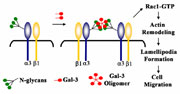
Proposed model of Gal-3-mediated signaling in epithelial cells leading to the formation of lamellipodial protrusions and cell migration. Reproduced with permission of the Journal of Cell Science. For full legend see doi:10.1242/jcs.045674
During wound healing, epithelial cells migrate across the wound bed, making and breaking contacts with the extracellular matrix and reorganizing their cytoskeleton as required. Signaling by transmembrane integrin receptors mediates both the external and internal processes of cell migration. Much of the study of integrin function has focused on protein–protein interactions, but binding of integrin N-glycans by galectins is also known to modulate signaling. Meanwhile, galectin-3 (Gal-3) has been implicated in the re-epithelialization of corneal wounds by an undefined mechanism. Now, in the Journal of Cell Science, Noorjahan Panjwani and colleagues report that Gal-3 binds complex N-glycans on α3β1 integrins, promoting Rac1 activation and the formation of lamellipodia during corneal wound healing. They propose that Gal-3-mediated cross-linking of the α3β1 integrin glycans promotes receptor clustering and pro-migratory signaling.
The membrane at the leading edge of motile cells forms a fan-shaped protrusion called a lamellipodium. To find out whether Gal-3 can initiate this migratory phenotype in human corneal cells, Panjwani and colleagues added the recombinant protein to cell culture. Exposure to Gal-3 induced the formation of lamellipodia in a dose-dependent manner, and only when the Gal-3 carbohydrate-recognition domain was not impeded by a competing sugar. Integrin α3β1 is known to mediate formation of lamellipodia, and an affinity assay revealed that it binds to Gal-3. Moreover, Gal-3 and α3 integrin colocalized at the sites of cell–cell and cell–matrix interactions, and Gal-3-induced lamellipodia formation was largely prevented by an antibody against the integrin.
A major pathway leading to the formation of lamellipodia involves activation of the GTPase Rac1, and the authors observed a 2.3-fold increase in Rac1 activation with exposure to Gal-3. As would be expected, focal adhesion kinase (FAK) was also activated in response to Gal-3. Surprisingly however, function-blocking antibodies against the α3β1 integrin ligand LN-332 did not prevent the Gal-3-induced response.
Having established that α3β1-integrin-Rac1 signaling is activated in Gal-3-stimulated lamellipodia formation, the authors turned their attention back to the interaction between the galectin and the integrin. The N-terminus of Gal-3 is known to mediate the formation of pentameric oligomers. The galectin ligand N-acetyllactosamine (Galβ1,4GlcNAc) is found on branched N-glycans, and the Gal-3 oligomers can cross-link complex glycans from one or more glycoproteins to form a lattice. Before elongation with lactosamines, glycan intermediates containing β1,6GlcNAc branches are synthesized by mannoside N-acetylglucosamine transferase 5 (Mgat5)1. In this study, the authors used short hairpin RNA to knockdown MGAT5 in epithelial cells, and detected a significant reduction in β1,6GlcNAc-branched glycans. Concomitantly, the formation of lamellipodia in response to Gal-3 was significantly reduced.
Clustering of integrins activates signaling, and the authors propose that cross-linking of Mgat5 glycans by Gal-3 oligomers clusters α3β1 integrin at the leading edge of migrating epithelia, activating FAK and Rac1 to promote lamellipodia formation and the re-epithelialization of wounds. Further work will determine whether Gal-3 binding to other glycoproteins is also involved, and will confirm whether Gal-3 can promote lamellipodia formation independently of LN-332.