Research Highlights
Influenza: Minimal sugar for more immunity
Functional Glycomics (12 November 2009) | doi:10.1038/fg.2009.36Standfirst
Trimming N-linked oligosaccharides on a viral coat protein affects the specificity and affinity of receptor binding, and might be an effective strategy for vaccine design.
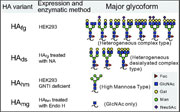
Schematic overview of hemagglutinin glycoforms. For full figure and legend see Wang et al., PNAS106, 18137–18142 (2009) doi:10.1073/pnas.0909696106
The interaction of hemagglutinin, a viral coat glycoprotein, with sialylated host cell receptors, is critical for establishing influenza infection. Hemagluttinin glycans influence antibody recognition and infectivity of the virus, and hemagglutinins from different viral strains have distinct host glycan preferences. However, little is known about how hemagglutinin glycan composition affects the protein structure, activity and immune response. Chi-Huey Wong and colleagues have now investigated the importance of glycan structure on both sides of the interaction. Their report, in Proceedings of the National Academy of Sciences, shows that both hemagglutinin and host glycan structures influence the strength of binding, and that reducing hemagglutinin glycans to a single residue elicits a greater immune response.
The authors used hemagglutinin from the pathogenic H5N1 avian influenza strain and constructed four glycoforms: fully glycosylated (HAfg), de-sialylated (HAds), high-mannose-type (HAhm) and monoglycosylated (HAmg). The binding of these was then investigated on an array of sialic acid glycans using fluorescent antibody hybridization, and the dissociation constants and free energies of binding were determined. Avian influenza binds to α-2,3-linked sialosides, not to α-2,6 sialosides, and this preference was confirmed. Each of the α-2,3 sialosides on the array terminated in a sialic acid residue preceded by a galactosamine. In the third position, variation was introduced by changing the residue, or by further elongation or branching. The changes that most affected hemagglutinin binding were addition of a sulfate group, which greatly increased it, and a branched fucose, which had the opposite effect.
The authors found that successive simplification of the N-glycans on hemagglutinin enhanced the affinity and relaxed the specificity of binding for α-2,3 sialosides. Furthermore, HAmg, with the simplest possible glycans attached, was a superior immunogen: the antiserum generated showed stronger neutralization of the virus, and it increased the protection of mice in a viral challenge study.
Understanding the infectivity and receptor tropism of influenza is critical to examine how individual strains cause pandemics or cross species barriers. The development of vaccines against the most highly pathogenic strains is a constant challenge. This study indicates that hemagglutinin with trimmed glycans elicits a greater immune response, and suggests that enzymatic modification of glycans might be an effective approach to facilitate future vaccine development.