Research Highlights
Carbohydrate synthesis: Engineering substrates rather than enzymes
Functional Glycomics (18 January 2007) | doi:10.1038/fg.2007.4Standfirst
Substrate engineering expands the repertoire of complex carbohydrates synthesized by glycosyltransferases.
Copyright © Nature Publishing Group
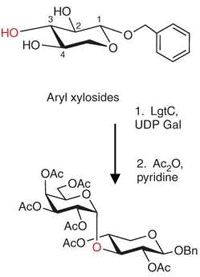
In contrast to peptides and nucleic acids, glycans cannot be synthesized simply in vitro due to the high selectivity of glycosyltransferases for both their donor and acceptor substrates. To broaden the range of possible reactions, Glycosyltransferases have been engineered in various ways. In Nature Chemical Biology, Lairson et al. report that they have now engineered transferase substrates instead of the enzyme itself in order to successfully synthesize di- and tri-saccharides.
The authors used the bacterial  -1-4-galactosyltransferase LgtC, which transfers galactose from uridine 5'-diphosphogalactose to lactose-containing acceptor substrates. They observed that galactose and other D-aldoses could be used successfully as acceptor substrates. When non-natural substrates were used the product consisted of a mixture of stereoisomers, and the substrate turnover was in most cases only about 0.1% of the turnover of the natural substrate.
Surprisingly, using p-nitrophenyl-d-glucopyranoside as an acceptor substrate Lairson et al. were able to produce only one stereoisomer. The binding pocket of glycosyltransferases is often hydrophobic—a fact that explains the small yield when using monosaccharides. Thus, the authors hypothesized that the stereochemical specificity of reactions catalyzed by LgtC may improve by attaching hydrophobic moieties to other monosaccharide substrates.
Lairson et al. tested this idea using monosaccharide acceptor substrates and were able to coax LgtC to attach galactose to a variety of 6-O-benzoate ester monosaccharide derivates.This substitution improved the product yield by a factor of 20 for mannose and only one stereochemical product was synthesized. Furthermore, the authors were able to use alkyl chain-substituted monosaccharides, opening the possibility for using substrate engineering in the preparation of glycolipids. Indeed, through careful selection of hydrophobic moieties and attachment points the authors were able to induce LgcT to make not only 1,4-linkages but also 1,2- and 1,3-linked products.
Overall, substrate engineering is less involved than the traditional approach of enzyme engineering for the synthesis of oligosaccharides, and the method described by Lairson et al. may find widespread application in biochemistry and drug discovery.