Research Highlights
Axonal development: Heparin brings growth cones to a halt
Functional Glycomics (08 February 2007) | doi:10.1038/fg.2007.5Standfirst
Heparin interacts with the Slit and Robo proteins to steer neurite growth cones.
Glycosaminoglycans — acidic polysaccharides consisting of amino sugars — are known to build up in the extracellular matrix of cells. Besides that, a role for glycosaminoglycans in cell signaling and migration is becoming increasingly clear. Directing neurite growth cones is a central example for the combination of these processes, and is modulated Slit/Robo signaling. Slit proteins are large secreted extracellular matrix proteins that bind to transmembrane Roundabout (Robo) proteins. Previously, the glycosaminoglycan heparan sulfate (HS) has been shown to be required for the in vivo activity of Slit. Hussain et al. now show in the Journal of Biological Chemistry that Slit/Robo signaling requires both proteins to associate with heparin, a member of the HS glycan family.
By analyzing truncated forms of the Slit and Robo proteins, the author found heparin binding sites at either end of the Slit protein and at the first two immunoglobulin domains of Robo, suggesting that heparin builds a ternary complex with the two proteins. Indeed, addition of heparin enhanced Slit/Robo binding affinity 10-fold. Binding of either Robo or Slit to the saccharide did not result in a stable complex, suggesting that only Robo and Slit together provide a high affinity binding site for heparin.
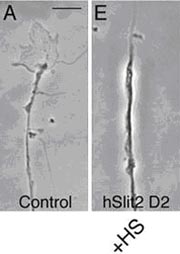
The authors used an assay of Xenopuslaevis retinal growth cones to look at these proteins under cell culture conditions as the cones are known to express Robo. The growth cones were embedded in a heparin- or HS-containing matrix. They collapsed after addition of a heparin-binding fragment of human Slit. Heparinase abolished this effect, whereas the addition of heparin reinstalled the collapse reaction. Using mutagenesis assays, the authors identified basic residues in the leucine-rich repeats of Slit as the binding sites for heparin.
These results bear a striking resemblance to the interaction between heparin and the fibroblast growth factor (FGF) and its receptor (FGFR). Binding of heparin, together with FGF binding, causes FGFR to dimerize and initiate signaling, although similar molecular consequences remain to be shown for Slit/Robo signaling. As heparin is a polysaccharide, the authors hypothesize that it may recruit several Slit molecules to Robo receptors, thus increasing their concentration for signaling through Robo.