Research Highlights
Blood groups: The A and B of microbes
Functional Glycomics (10 May 2007) | doi:10.1038/fg.2007.18Standfirst
Two recently discovered classes of bacterial glycosidases effectively cleave the A and B blood group antigens from erythrocytes, opening up the possibility of universal blood cell production.
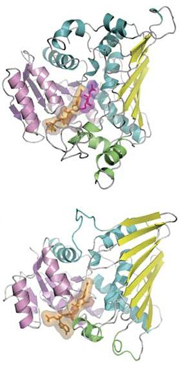
Structures of E. meningosepticum alpha-N-acetylgalactosaminidase (top) and Zymomonas mobilis glucose-fructose oxidoreductase (PDB 1OFG) (bottom). The NAD+ molecule and GalNAc bound to the alpha-N-acetylgalactosaminidase and the NADP+ cofactor bound to 1OFG are highlighted.
AB0 blood groups are defined by the presence of terminal  -1,3 bound N–acetylgalactosamine (A antigen) or galactose (B antigen) on erythrocyte surface glycans. During blood transfusion, both donor and recipient AB0 groups must match to prevent hemolysis. Blood group 0 erythrocytes, which lack both terminal carbohydrates, can be used for any type of recipient and are thus termed "universal red blood cells" (UBCs). Glycosidases such as the coffee bean glycosidase are able to convert blood group A or B erythrocytes into UBCs by specifically cleaving terminal carbohydrates. However, these glycosidases have low catalytic activity and work at pH values far from the erythrocyte optimum. In Nature Biotechnology, Liu et al. characterize two classes of bacterial glycosidases that effectively convert A/B erythrocytes into UBCs at a neutral pH.
Liu et al. screened 2500 bacterial isolates and identified the known but untested –N–acetylgalactosaminidase from Elizabethkingia meningosepticum as cleaving the A antigen. Three more prokaryotic glycosidases were found by protein sequence comparison with the E. meningosepticum enzyme that also showed the desired enzymatic activity. Next, Liu et al. identified an -galactosidase from Streptomyces griseoplanus that specifically cleaved the B antigen. Again, five similar glycosidases were found by sequence comparison.
The authors report that the identified –N–acetylgalactosaminidases show greater similarity to oxidoreductases than to other glycosidases, and also require bound NAD+ for enzymatic activity. This observation led the authors to elucidate the unusual three-dimensional structure of the found glycosidases by X-ray crystallography. Likewise, the found –galactosidases had no strong sequence similarity to other known glycosidases. These findings indicate that the identified enzymes represent two novel classes of glycosidases.
Liu et al. went on to demonstrate that the bacterial glycosidases successfully cleaved the carbohydrate antigens in a series of group A and B erythrocyte samples taken from different donors. Chemical and immunological analysis showed that the antigens were entirely eliminated after enzymatic treatment. Furthermore, the conversion procedure did not affect the physiological functions of the erythrocytes, and small amounts of enzymes – 0.1% of the amount reported for the coffee bean glycosidase – were sufficient for cleavage.
As the identified enzymes can be expressed easily in E.coli, production of the enzymes on a large scale and application of the enzyme assays in clinical practice appears to be possible. This discovery may make a long kept dream of modern transfusion medicine come true.