Featured Articles
T cells: Home sweet home
Functional Glycomics (10 May 2007) | doi:10.1038/fg.2007.19Standfirst
The L-selectin ligand 6-sulfo sialyl Lewis X, known to be a capping structure of O-glycans, is also present on the N-glycans of endothelial cell surface proteins to guide the homing of lymphocytes.
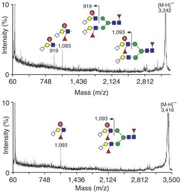
Mass spectra showing that N-glycans of lymph node endothelial cells carry sulfo sLeX.
Protein-carbohydrate interactions guide the migration or homing of lymphocytes from blood vessels to the lymphatic system. In the first step of homing, lymphocytes stop to float in the bloodstream and start to roll over and tether to the cell walls of specialized blood vessels called high endothelial venules (HEVs). In HEVs, the lymphocyte L-selectin interacts with its ligand, the 6-sulfo sialyl Lewis X (6-sulfo sLeX) tetrasaccharide on endothelial transmembrane proteins, which results in rolling and tethering. Until recently, 6-sulfo sLeX was thought to be carried by only two — core1 and core2 — of the eight known core structures of mucin-type O-glycans, linked to proteins such as GlyCAM-1. Mitoma et al. now show in Nature Immunology that 6-sulfo sLeX is also found on N-glycans on endothelial cell surface proteins.
Mitoma et al. generated mice lacking core1 glycosyltransferase and observed that rolling of T and B lymphocytes was reduced but not eliminated. This finding mirrored consequences reported previously for an ablation of core2 transferase. Surprisingly, Mitoma et al. found that rolling of lymphocytes from double-knockout mice lacking both core1 and core2 glycosyltransferase was still in the range of 50% when compared to wild-type lymphocytes. This result suggests that mucin-type O-glycans other than core1 or core2 structures might carry the 6-sulfo sLeX ligand. This possibility was excluded by the observation that GlyCAM-1 — possessing O-glycans only — from double-knockout mice did not support lymphocyte rolling. On the other hand, removal of N-glycans from endothelial tissue of double-knockout mice resulted in a complete loss of L-selectin binding. Homing also disappeared in double-knockout mice and decreased in wild-type mice after the mice were treated with a lectin binding to N-glycans, thereby occluding terminal carbohydrates. These results indicate that 6-sulfo sLeX on N-glycans is the L-selectin ligand responsible for residual rolling in double-knockout mice and a significant portion of rolling in wild-type mice.
This hypothesis was confirmed by the mass spectrometric detection of 6-sulfo sLeX on endothelial cell N-glycans. The role of the novel structure was directly shown in vivo, as Chinese hamster ovary cells expressing 6-sulfo sLeX on N-glycans supported lymphocyte rolling. Lastly, Mitoma et al. identified the CD34 glycoprotein as the primary carrier of N-glycans terminated by the 6-sulfo sLeX tetrasaccharide. The results of Mitoma et al. reveal the general importance of 6-sulfo sLeX in the lymphocyte homing process. Second, both CD34 and GlyCAM-1 belong to the mucin family of transmembrane proteins that share an extended rod-like shape. This indicates that L-selectin requires a structurally similar protein scaffold for its 6-sulfo sLeX ligand. As L-selectin ligands are involved in inflammatory diseases such as ulcerative colitis and Helicobacter pylori infection, future studies may identify a specific role for 6-sulfo sLeX on N-glycans in such diseases.