Featured Articles
Glycomics: Gathering glycans from glycolipids
Functional Glycomics (10 May 2007) | doi:10.1038/fg.2007.20Standfirst
The integration of analyses of glycans linked to lipids with those linked to proteins is an innovative step towards high-throughput glycomics.
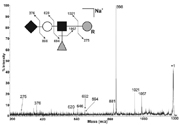
Mass spectrum of an O-mannose glycan revealing that this glycan contained a potential sialyl Lewis x epitope. Copyright © 2007 Oxford University Press.
Although the relevance of protein glycosylation is well established, the role of glycosylated lipids in processes such as immunomodulation and cell-fate decision has only recently emerged. This highlights the importance of glycomics studies that consider the entirety of glycans — those linked to both lipids and proteins — in a given cell type. However, the different physicochemical properties of glycoconjugates hamper integrated glycosylation analysis. Using unpolar solvents to extract glycolipids complicates subsequent glycan cleavage by enzymes or chemical reagents. Additionally, mass spectrometric data from whole glycolipids and glycans isolated from glycoproteins cannot be interpreted uniformly as they originate from two different substance classes. In Glycobiology, Parry et al. now describe a glycomics approach whereby glycans from both carrier molecules can be isolated and then analyzed in the same way.
The authors extracted glycoproteins and glycolipids from mouse tissue and collected each of the glycoconjugates separately. After searching suitable reagents, Parry et al. found that ceramide glycanase was able to cleave glycans from hydrocarbon chains in the glycolipid mixture. In the glycoprotein fraction, carbohydrate chains were isolated by known chemical reagents and enzymes. Next, the isolated glycans from each mixture were chemically modified to maximize the structural information that could be obtained by mass spectrometric analysis. This rapid and uniform treatment of carbohydrate structures from both glycoconjugates paves the way for high-throughput glycomics studies.
Parry et al. evaluated the efficiency of the proposed way to isolate and analyze glycans from glycolipids by comparing glycan profiles from lipid fractions of mouse testes, liver and kidney. In addition to finding known sugar structures, the authors discovered previously undescribed fucosylated glycans. These results indicate that this approach to glycolipid analysis might be more effective than known techniques.
The authors then turned their experimental strategy toward glycomics of the mouse brain. Surprisingly, Parry et al. discovered the presence of sialyl Lewis x (sLex) in the brain, which is known to act as a ligand in immune processes under normal circumstances. The tetrasaccharide sLex usually caps mucin-type O-glycans, the most common serine or threonine hydroxyl group-linked glycan, but Parry et al. detected sLex on rare mannose O-glycans. The biological significance of this structure remains to be determined.
The integrated glycomics strategies presented by Parry et al. can easily be augmented with combined gas chromatography-mass spectrometry in order to identify carbohydrate linkage types and uncover the identity of hexose isomers. The application of the proposed technique may even reveal more surprising and biologically significant glycans in cellular proteins and lipids in future glycomics studies.