Featured Articles
Tumor growth: At the end of a snake bite
Functional Glycomics (14 June 2007) | doi:10.1038/fg.2007.23Standfirst
The C-type lectins lebectin and lebecetin isolated from the venom of the blunt-nosed viper (Macrovipera lebetina) have been shown to inhibit tumor angiogenesis through a direct interaction with epithelial cell integrins.
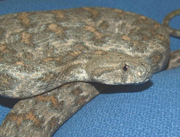
Macrovipera lebetina
Angiogenesis is essential for embryogenesis and tumor growth as it enables growing tissue to receive a steady supply of nutrients. It involves both cell migration and adhesion processes, during which integrins, endothelial cell surface glycoproteins, interact with collagen and fibronectin in the extracellular matrix. Some snake venom proteins interfere with this interaction and have previously been proposed as anti-cancer drugs due to their ability to inhibit angiogenesis. In two publications in the Journal of Cellular Physiology and Matrix Biology, José Luis and colleagues now describe two C-type lectins from the venom of Macrovipera lebetina that block tumor angiogenesis by directly interacting with endothelial integrins.
Luis and colleagues previously noted that M. lebetina lebectin and lebecetin diminish tumor cell adhesion, migration and invasion. In their current studies they investigate lebectin and lebecetin's effect on angiogenesis using human brain endothelial cells (HBMEC). HBMECs are involved in angiogenesis of brain tumors, which often do not respond to cytostatic drugs. The authors also explore the specificity of lebectin and lebecetin's interactions with various integrin subtypes expressed in tumor cell lines.
The authors found that lebectin and, to a smaller extent, lebecetin inhibited adhesion, migration and proliferation of HBMECs. Using the chicken chorioallantoic membrane assay they confirmed that angiogenesis was inhibited by both lectins in vivo. FACS analysis showed that HBMECs predominantly express  V
V 3, V5 and 51 integrins - the major receptors for the essential angiogenic factors fibronectin and vitronectin. Indeed, HBMECs treated with lebectin did not adhere to anti-5 integrin antibodies, pointing to a direct interaction between lebectin and HBMEC 5-integrin.
Lebectin and - albeit less so - lebecetin also blocked adhesion of fibronectin to tumor cells expressing V6 integrin as well as V3, V5 and 51 integrins. Immunoprecipitation using HBMEC and tumor cell integrins confirmed that both CLPs interacted directly with the cell adhesion factors. Luis and colleagues hypothesize that lebecetin's reduced inhibition of adhesion may be due to its heterodimeric structure, which favors integrin interactions that do not abolish their adhesive functions.
The authors speculate that lebectin and lebecetin might stabilize a conformation of the integrins which does not have adhesive potential. Both lebectin and lebecetin lack the RGD amino acid motif normally involved in the integrin-ECM interaction, yet they have regions which are structurally homologous to the carbohydrate-binding domain of C-type (calcium-dependent) lectins. Thus, further studies that focus on the possible involvement of integrin glycans in the CLP-integrin interaction are needed. As the 51 integrin is almost exclusively expressed in growing vessels, lebecetin and lebecetin might provide a selective anti-cancer treatment that targets growing tumor vasculature without affecting existing blood vessels.