Research Highlights
Siglecs: Sugars signal stop
Functional Glycomics (12 July 2007) | doi:10.1038/fg.2007.30Standfirst
Mouse sialic acid-binding immunoglobulin-like lectin-G (Siglec-G) is a B-cell receptor that inhibits calcium signaling and cell proliferation.
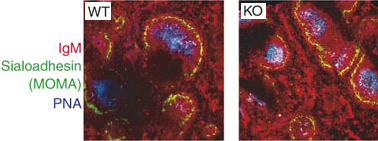
Spleen histology at day 10 after mice were immunized with sheep red blood cells; sections are stained with anti-IgM (red), anti-sialoadhesin (MOMA; green) and peanut agglutinin (PNA; blue) to show germinal center architecture
The Siglec family of transmembrane receptors are expressed on glial and immune cells and bind sialic acid-containing pathogenic glycoepitopes, thereby enhancing the immune defence against microorganisms. CD33-related Siglecs such as Siglec-G, which possess an intracellular immunoreceptor tyrosine-based inhibitory motif (ITIM) and an ITIM-like motif, have been chiefly implicated in cell proliferation and signaling of cell types such as natural killer cells. On the other hand, the negative regulator that prevents B1 cell population expansion and calcium signaling is still elusive. B1 cells are distinct from B2 cells in that they are the main source of antibacterial and polyreactive IgM responses. Reporting in Nature Immunology, Hoffmann et al. now show that Siglec-G represses B1 cell proliferation and calcium signaling, thereby revealing a new link between carbohydrate binding and signaling pathways.
B-cell receptor (BCR)-mediated calcium signaling was reduced in a chicken B cell line virally transduced with Siglec-G, providing a first insight into the physiological function of Siglec-G. Likewise, the calcium response elicited by anti-IgM was significantly higher in B1a cells from Siglecg-/- mice than in cells from wild-type mice, and they had a markedly increased number of B1a cells in the first week after birth. Hoffmann et al. found no difference in the phosphorylation status of proximal BCR signaling proteins such as phospholipase C- between wild-type and knockout B1 cells, suggesting that the increase in calcium signaling observed in Siglec-/- B1 cells was not due to increased activation of the BCR-signaling cascade. Furthermore, Siglec-G does not act as an inhibitor of BCR-mediated B cell proliferation induced by either anti-IgM or lipopolysaccharide.
However, consistent with the increase in B1a cells in Siglecg-/- mice post birth, both the IgM titer and the number of IgM-secreting cells in these mice were increased. Likewise, the authors observed an increase in IgM-isotype autoantibodies, while the number of IgG autoantibodies was not raised. In older mice, Hoffmann et al. detected an increase in anti-IgG/anti-IgM idiotype rheumatoid factor — an indicator of rheumatoid arthritis in humans.
These results delineate Siglec-G's function as a B1a cell receptor that inhibits calcium signaling and B1a cell population expansion after birth, thus providing protection against autoimmune responses. Further studies may show that the recruiting of SHP by ITIM, which has been shown to be present in other cell types expressing Siglec-G, is connected to B1a cell proliferation and signaling. As well as providing a fresh perspective on the signaling properties of carbohydrate-binding receptors, the study of Hoffmann et al. contributes to our understanding of autoimmune reactions in rheumatoid disease.