Featured Articles
Autommunity: Macrophages hunting mannose singles
Functional Glycomics (13 September 2007) | doi:10.1038/fg.2007.37Standfirst
Macrophage accumulation in the kidneys of systemic lupus erythematosus patients is caused by the presence of proteins possessing simplified N-glycan structures.
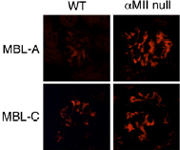
Mannose-binding lectin (MBL) deposition in kidney glomeruli of 6-month-old mice of the indicated genotypes. Copyright © 2007 Elsevier B.V.
Systemic lupus erythematosus (SLE) is an autoimmune disease that is often accompanied by kidney pathologies. The molecular mechanism leading to SLE is unknown, but mice lacking  -Mannosidase-II (M-II) develop a SLE-like syndrome. Absence of M-II leads to the presence of simple N-glycans that are typically characteristic for pathogens, instead of the complex branched N-glycans found on vertebrate cell surface glycoproteins. However, as most cells express an isozyme of M-II only a few cell types lack complex N-glycan expression. Publishing in Immunity, Green et al. now detail the connections between a lack of M-II and SLE-related kidney disease.
Green et al. excluded an ontogenic defect of the kidneys from SLE pathogenesis and, by bone marrow reconstitution experiments, also excluded a role for bone-marrow-derived cells. However, mice deficient in recombination activating genes (RAG) — which cannot generate functional B and T cells — showed a more severe disease. According to the authors, this may reflect that immunoglobulin-G (IgG) produced by B cells increases Fc receptor activity, which in turn attenuates immune activation. This idea was confirmed by the finding that IgG administration dampened SLE-like symptoms.
Importantly, mice lacking M-II exhibited early macrophage infiltration in the kidneys, and macrophage presence led to inflammation and formation of reactive oxygen species. Kidney mesangial cells produced monocyte chemoattractant protein-1 (MCP-1), which is known to recruit and activate macrophages in the kidney. Green et al. tested the response of mesangial cells to a variety of mannose-containing glycans as these cells contain lectin receptor that recognize the mannose glycoepitopes presented by lower eukaryotes. The authors found that MCP-1 production was induced upon exposure of mesangial cells to yeast cell wall mannan or, most importantly, serum from M-II-deficient mice. Furthermore, cytological examination of kidney tissue from M-II-deficient mice confirmed the presence of mannose-binding lectin receptors in vivo.
To sum up the results from this study, the authors conclude that glycoproteins carrying 3 and 6 mannose linkages common to N-glycans of lower eukaryotes and some pathogens are released from specific cell types and accumulate in organs such as the kidneys. Here they are recognized as non-self by mannose binding lectins of the innate immune system. This in turn leads to a sterile inflammatory response resulting from MCP-1 production, macrophage infiltration and activation, that can induce autoantibody formation, and eventually kidney failure. Further research should reveal whether this novel mechanism of autoimmune disease is involved in human inflammatory and autoimmune sicknesses, and whether inhibiting mannose lectin function may be therapeutic in such contexts.