Research Highlights
Gut epithelium: Bacterial fauna fosters fucosylation
Functional Glycomics (13 September 2007) | doi:10.1038/fg.2007.38Standfirst
Bacterial colonization of the neonatal gut epithelium leads to enhanced ERK and JNK signaling, which results in an increased fucosylation of epithelial glycoproteins.
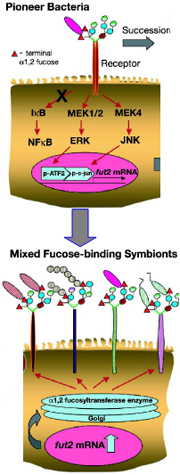
Changes in the bacterial colonization of the gut lead to altered glycosyltransferase expression. Copyright © 2007 by the American Physiological Society.
Upon bacterial colonization of the colonic epithelium, there is an alteration in epithelial cell glycosylation where sialic acid is often replaced by fucose as the terminal carbohydrate of glycan. Elucidation of the connection between altered glycosylation and bacterial colonization is of importance as bacterial gut fauna increasingly appear to be a focal point in human health. In the American Journal of Physiology: Gastrointestinal and Liver Physiology, Meng et al. now pinpoint the signaling pathway connecting bacterial presence and altered glycosylation.
The authors observed that administering bacteria to mice raised under germ-free conditions led to a drastic increase in  1,2- and 1,3-fucosyltransferase activity. This enzymatic change was mirrored by an increase in corresponding 1,2-fucosyltransferase gene II mRNA levels and by increased lectin recognition of 1,2-bound fucose. Meng et al. analyzed changes in the signaling intermediates known be involved in mammalian cell bacterial contact. They found that MEK1/2 and ERK1/2 — downstream effectors of the ERK signaling pathway — were phosphorylated upon bacterial colonization, as were the JNK pathway effectors MKK4 and JNK. Importantly, these signaling intermediates were found neither in germ-free nor in conventionally grown mice; however, whereas prototypic inflammatory signaling pathways such as NF-
 B signaling remained unchanged. These results indicate that ERK and JNK signaling pathways are transiently upregulated upon bacterial inoculation, which may cause altered glycosylation.
Meng et al. then administered specific inhibitors of ERK and JNK signaling pathways to bacteria-depleted mice leading to an abatement of 1,2-/1,3-fucosyltransferase upregulation. However, this was absent in mice grown under germ-free or conventional conditions throughout their lifespan. These results confirm that exposing germ-free gut mucosa or the bacteria-depleted conventional mice to bacteria transiently activates ERK and JNK signaling, leading to a more permanent upregulation of fucosyltransferase expression and enhanced epithelial fucosylation.
Bacterial colonization of the gut might diminish the susceptibility to autoimmune diseases or enteric pathogen infection by upregulating terminal glycan fucosylation, which is known to occlude immunogenic glycan epitopes such as N-acetylgalactosamine. Consistent with this idea, mice unable to perform fucosylation by abrogation of GDP-fucose synthesis — a necessary substrate for fucose transfer to glycoproteins — develop colitis. At the same time, the increased presence of specific carbohydrates might be of benefit to bacterial growth, suggesting a reciprocal symbiotic relationship between the gut and its flora. More research into the mutual relationship of epithelial glycosylation and bacterial presence may uncover further effects on human health.