Research Highlights
Carbohydrate antigens: Toll-like receptors pay off in tumor vaccine design
Functional Glycomics (11 October 2007) | doi:10.1038/fg.2007.43Standfirst
A novel vaccine that contains a Toll-like receptor 2 agonist elicits a specific immune response against tumor-related carbohydrate antigens.
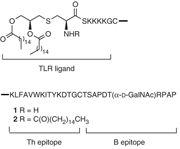
Structure of the synthetic three-component vaccine. Click here for the full figure.
A hallmark of a cell's oncogenic transformation is the appearance of immunogenic glycan structures such as single N-acetylgalactosamine (Tn-antigen) molecules on the cell surface. Attempts to create therapeutics that elicit a immune response against such tumor-related antigens have as yet been fairly unsuccessful; the immune system has a high tolerance towards the glycan as it is a self-antigen, and carrier proteins such as the keyhole limpet hemocyanine (KLH) cause B-cell responses which can suppress the glycan-oriented immune response. In Nature Chemical Biology, Ingale et al. now describe the development of a carbohydrate vaccine in mice that surmounts these immunogenicity problems.
The authors performed the total synthesis of a three-component vaccine that contained a Toll-like receptor 2 (TLR2) agonist peptide, a T-helper cell epitope and the tumor-associated carbohydrate epitope. By expressing various TLRs in human embryonic kidney cells, Ingale et al. showed that only TLR2-expressing cells were readily taking up the TLR2 agonist, leading to the hypothesis that the vaccine would cause cytokine production specifically at the site of interaction with immune cells.
Next, Ingale et al. immunized BALB/c mice with the vaccine and found that the IgG3 titer, which is characteristic of an anti-carbohydrate response, increased 35-fold compared to the non-immunized state. Sera from immunized mice bound strongly to MCF7 human breast cancer cells, which express a high amount of the mucin-like MUC1 tumor antigen protein multiply glycosylated with the Tn antigen. Furthermore, the presence of the tumor-necrosis factor  and immune costimulatory proteins such as CD80 indicated that the immune response was TLR2-dependent, confirming the specificity of the vaccine.
Taken together, the vaccine as chemically synthesized by Ingale et al. circumvents the weak and unspecific immune response that plagued previous vaccines designed against tumor-related carbohydrates. The results of the present study are a very promising step towards a carbohydrate-based anti-tumor vaccine.