Research Highlights
Carbohydrate-binding receptors: Siglec-2 in a tight bind
Functional Glycomics (08 November 2007) | doi:10.1038/fg.2007.46Standfirst
Sulfation of glycan N-acetyllactosamine components carrying terminal-bound  2,6 sialic acid enhances binding of CD22 (Siglec-2), and may be involved in B cell migration.
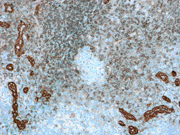
Distribution of the SSL (dark patches) in human peripheral lymphoid tissue. Image by courtesy of Dr Reiji Kannagi, Aichi Cancer Center Research Institute, Nagoya, Japan.
Lymphocyte activation and migration depends critically on specific cell surface glycans and glycan-binding receptors. Among these receptors, the B-cell sialic acid-binding receptor CD22 — also known as sialic acid binding immunoglobulin-like lectin 2 (Siglec-2) — recognizes glycans carrying terminal-bound 2,6 sialic acid. Modifications of 2,6 sialic acid are known to change CD22 affinity. CD22-ligand interactions in cis prevent ligand binding in trans and thereby increase the threshold for B-cell activation. In mice, conversion of the sialic acid N-acetyl group to the N-glycolyl group by the CMP-sialic acid hydroxylase (CMAH) creates a better ligand for CD22. As humans do not have a functional CMAH it raises the question as to whether CD22 is modified in humans. Now, in the Journal of Biological Chemistry, Kimura et al. report evidence that sulfated N-acetyllactosamine in 2,6 sialylated glycans (SSL) binds CD22 with a greater affinity than the unsulfated form.
The authors generated a SLL-specific antibody (KN343). They incubated KN343 with various different B-cell lines and found that the Nawalma B-cell line expressed SLL most strongly. Nawalma cells were also found to bind strongly to CD22, which was eliminated upon addition of the KN343 antibody, confirming that the interaction of CD22 with SSL is specific. Furthermore, sulfation inhibition in a cell line expressing CD22 increased the adhesion of these cells to another cell lines expressing SSL, supporting the hypothesis that cis interactions between CD22 and SSL dampen the interaction between CD22 and its ligands in trans.
Kimura et al. found that SSL was particularly abundant on CD19+ B cells and CD56+ natural killer cells, but only very weakly detectable on CD3+ T cells. Importantly, SSL, but not the unsulfated form of the ligand, were found in high endothelial venules. These findings point to a role for SSL in the recruitment and homing of B lymphocytes.
The results of Kimura et al. establish SSL as a novel interaction partner for CD22 in B-cell recruitment. The current study is a further step towards pinpointing all carbohydrate ligands and receptors that contribute to leukocyte fate, which would greatly aid the therapeutic manipulation of the immune response.