Research Highlights
Macular degeneration: Getting the GAG
Functional Glycomics (08 November 2007) | doi:10.1038/fg.2007.47Standfirst
Changes in the glycosaminoglycan (GAG) binding preference of factor H (FH) may contribute to the pathogenesis of age-related macular degeneration
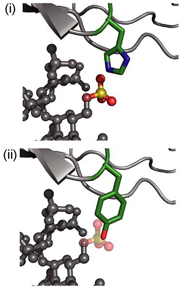
A structural model illustrating the proposed ability of the FH Y402H polymorphism to differentially bind sulfated sugars. © The Rockefeller University Press
Age-related macular degeneration (AMD) is a vision-impairing disease that affects approximately 50 million people worldwide. A tyrosine to histidine substitution of the glycoprotein factor H (FH Y402H) has been shown to be a risk factor for AMD, but the details of AMD pathogenesis remain elusive. FH is part of the alternative pathway of the complement system that mediates self/non-self recognition processes. The Y402H polymorphism is located in the short consensus repeat (SCR) 7 of FH, and SCR7 contains a binding site for sulfated glycosaminoglycans that has been shown previously to affect GAG-FH interactions. Results of the report by Prosser et al. in the Journal of Experimental Medicine now provide a molecular explanation as to how these tyrosine and histidine variants differentially recognize GAGs.
The authors examined the crystal structure of an FH fragment for the AMD-associated variant (H402), consisting of SCRs 6-8, bound to sucrose octasulfate (SOS) — a mimic of highly sulfated GAGs. The structure demonstrates that H402 is directly hydrogen bonded to a SOS sulfate group, whereas a tyrosine at this position would be unable to support this interaction. This finding is consistent with earlier studies showing that the H402 and Y402 variants have different affinities and specificities for sulfated GAGs, where the former is more sensitive to changes in sulfation. Moreover, the authors found that this GAG binding site occupies the center of an interaction groove that extends into SCRs 6 and 8, where a single bound GAG molecule could span between these modules.
The current study highlights how subtle alterations in GAG sulfation patterns could influence pathogenesis. Such sulfation changes occurring in the eye with increasing age may differentially affect the localization and relative rentention of the H402 and Y402 polymorphic forms of FH in the retina. This could lead to an imbalance in regulation and activation of the complement system, which is believed to play a key role in macular degeneration. As well as bringing us closer to AMD treatment or prevention, future studies may reveal similar changes in the interaction between GAGs and carbohydrate-binding proteins that lead to other diseases.