Featured Articles
Carbohydrate recognition: A chemistry lab's lectin mimicry
Functional Glycomics (08 November 2007) | doi:10.1038/fg.2007.48Standfirst
Specific carbohydrates can be recognized in a lectin-like way by small, chemically synthesized molecules.
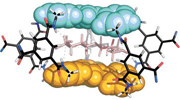
A computational model of the receptor-cellobiose complex showing a cellobiose molecule sandwiched between aromatic hydrocarbons.
© 2007 American Association for the Advancement of Science.
Chemically synthesized carbohydrate-binding receptors are potentially important for basic and clinical research. However, their development is challenged by the fact that the hydroxy groups of sugars bear a high similarity to water. This fact is mirrored by the comparatively low affinities of lectins — nature's carbohydrate binding proteins (CBPs) — for their substrates. While a variety of sugar receptors have been constructed for organic solvent solutions, receptors for water-dissolved sugars have only recently been synthesized. Reporting to Science, Ferrand et al. now describe a receptor design that has a high specificity for the disaccharide cellobiose (1- -D-glucopyranosyl-4-D-glucopyranose). Cellobiose offers a relatively simple starting point for receptor design as all hydroxy groups are in a single plane; in contrast, galactose has one hydroxy group that is almost orthogonally oriented toward the others, thus imposing additional demands on receptor synthesis.
The authors applied molecular modeling to design a structure that consisted of a hydrophobic "roof" and "floor" made of aromatic hydrocarbons, which have a high affinity to the hydrophobic carbon ring of the two hexoses. The side "pillars" of the model molecule contained isophthalamide units that would allow the molecule to form hydrogen bonds with the sugar's hydroxy groups. Ferrand et al. used five pillar isophthalamides to avoid a collapse of the cavity engulfed between the aromatic groups. Tricarboxylate units attached to the pillars were intended to confer water solubility to the molecule.
The chemically synthesized receptor was exposed to a solution of cellobiose in water, and the binding was physicochemically measured by circular dichroism and isothermal titration. Ferrand et al. discovered that the cellobiose-receptor binding was chiefly driven by enthalpic interactions of the binding partners and not by entropic effects due to the hydrophobic and hydrophilic features of the system. The observation that the measured binding constants compared well to the affinities of some lectins also corroborated the success of the receptor design.
Applying nuclear Overhauser effect spectroscopy, the authors confirmed that the disaccharide was indeed sandwiched between the hydrocarbon units and that the hydroxy groups were bound by the amide groups of the pillars. Lastly, the binding selectivity was affirmed by using a panel of di- and monosaccharides. Both lactose, which is stereochemically different from cellobiose in the position of only one hydroxy group, and gentiobiose, whose molecular structure is slightly more extended than cellobiose, showed almost no binding.
Taken together, Ferrand et al. for the first time have synthesized a small molecule that mimics the binding properties of lectins in terms of selectivity and affinity to the ligand. Their results offer a starting point for the synthesis of chemically well-defined small carbohydrate binding molecules, which can be used for glycan analysis and further investigation of the mechanism of protein-carbohydrate binding.