Research Highlights
Pregnancy immunology: Gal-1 fights for the fetus
Functional Glycomics (10 January 2008) | doi:10.1038/fg.2008.4Standfirst
Galectin-1 (Gal-1) acts synergistically with progesterone to generate fetal antigen tolerance by skewing the TH cell population towards an anti-inflammatory profile.
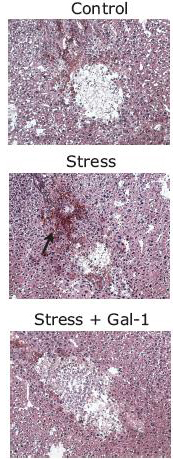
Cellular infiltrations (middle picture, arrow) in tissue derived from pregnant mice after stress exposure, reflecting the initiation of fetal loss. No signs of fetal loss either in control (top) or stress-challenged mice treated with Gal-1 (bottom).
Galectins are a group of lectins that specifically bind  -galactosides. Gal-1 has been shown to induce apoptosis of T helper (TH) 1 and TH-17 cells by binding to their surface glycans. TH2 cells are insensitive to Gal-1-induced apoptosis, as the sialylation of TH2 cell glycans blocks any potential interaction with Gal-1. This regulation leads to an anti-inflammatory response, and Gal-1 has been used in animal models of autoimmunity to prevent TH1- and TH-17-dependent inflammation. Interestingly, during pregnancy Gal-1 expression is upregulated in human uterine endometrium and natural killer cells. Now in Nature Medicine, Blois et al. show how Gal-1 contributes to the immunological tolerance of maternal leukocytes towards fetal alloantigens.
Sonic stress induces pregnancy failure in mice, and the authors noted that Gal-1 treatment of sound-stressed mice markedly diminished the rate of fetal loss. Previous studies found that the regulatory potential of uterine dendritic cells (DCs) can instruct the differentiation of TH2 cells in the endometrium which is critical for pregnancy maintenance. Blois et al. found that lymph nodes of stress-challenged mice harbored a higher frequency of mature DCs than controls following stress exposure. Interestingly, this effect was reverted by Gal-1 treatment, and Gal-1-deficient mice had increased fetal loss compared to wild-type littermates. Thus, Gal-1 appears to support pregnancy maintenance by regulating the T helper cell profile.
Blois et al. found that stress increased the ratio of proinflammatory TH1-type cytokines to anti-inflammatory TH2-type cytokines and resulted in fewer CD4+CD25+ interleukin (IL )10+ regulatory T cells, which are critical for counteracting harmful T cell responses. All of these stress-related effects were mitigated by Gal-1 treatment. Moreover, transplanted DCs from Gal-1-treated mice prevented fetal loss in untreated stressed mice and shifted the cytokine balance towards a TH2-dominant profile. These results demonstrate the Gal-1 anti-inflammatory effect in vivo.
Interestingly, progesterone-treated mice had more Gal-1 than untreated mice, and Gal-1 administration in turn led to higher progesterone levels. The emerging hypothesis of a hormone-lectin synergism was confirmed by cell culture experiments, suggesting that Gal-1 is an upstream component of the progesterone signaling pathway.
Taken together, Blois et al. show that Gal-1 acts synergistically with progesterone to shift the uterine leukocyte population towards an anti-inflammatory profile. Future research about Gal-1's role in human reproduction may help prevent fetal loss in threatened pregnancies.