Research Highlights
Diabetes: An OGT way to insulin resistance
Functional Glycomics (13 March 2008) | doi:10.1038/fg.2008.14Standfirst
The O-glycosylation of insulin signaling PI(3)K pathway components supports insulin resistance and provides a novel mechanism of regulation for insulin signaling.
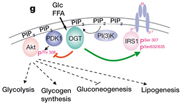
PIP3-recruited OGT attenuates insulin signalling by inhibiting Akt phosphorylation and promoting IRS1 phosphorylation. Click here for a larger picture. From Yang et al.
N-acetylglucosamine (GlcNAc) acts through O-GlcNAc transferase (OGT) to O-glycosylate intracellular proteins, such as the tumor suppressor p53. This regulates their function and can act complementary to phosphorylation. The building blocks of GlcNAc synthesis — glucose, glutamine and acetyl-coenzyme A — connect GlcNAc to each of the major metabolite classes. Thus, O-GlcNAcylation has been considered to mediate metabolism and insulin signaling. Now in Nature, Yang et al. dissect the effect of protein O-GlcNAcylation on insulin signaling.
Yang et al. noticed that the OGT N terminus harbors a binding site for phosphatidylinositol (3,4,5)-trisphosphate (PIP3). Therefore, OGT may be a target of phosphoinositide 3-kinase (PI(3)K), which produces PIP3 as a mediator of insulin signaling. Indeed, functional inhibition or mutation of PI(3)K blocked the rapid plasma membrane translocation of OGT and protein kinase B (Akt) upon cell stimulation.
Inhibiting N-acetylglucosaminidase raised intracellular O-GlcNAcylation and led to the selective phosphorylation of Akt and the signaling adaptor IRS1 (insulin receptor substrate 1) at sites known to attenuate insulin signaling. Kinases involved in insulin signaling, such as Akt, PDK1 (3-phosphoinositide-dependent protein kinase 1) and the catalytic subunit of PI(3)K were found to be O-GlcNAcylated. This suggests that O-GlcNAcylation attenuates the PI(3)K branch of insulin signaling, which regulates the presence of the glucose transporter on the cell surface.
Mice receiving adenoviral delivery of OGT (AdOGT mice) showed increased insulin plasma levels relative to controls, indicating that O-GlcNAcylation-induced increases in insulin secretion attenuated insulin signaling. Consistent with the idea of insulin resistance in AdOGT mice, Yang et al. found that the animals showed a delayed decrease in blood glucose levels and increased gluconeogenesis in the liver. Furthermore, expression of lipogenic transcription factors was reduced, leading to an increase of blood triacylglycerols and cholesterols.
The results of Yang et al. suggest that PI(3)K translocates OGT to the cell membrane, where it O-GlcNAcylates components of the PI(3)K signaling pathway, and together with phosphorylation, mediates the attenuation of insulin signaling. High concentrations of glucose and lipids can mimic insulin resistance via increased GlcNAc synthesis and enhanced O-GlcNAcylation. This study adds to the evidence that the connection between metabolic state and signal transduction is one of the many functions of glycosylation in the cell.