Research Highlights
Lymphoma infiltration: Selectin' leukosialin
Functional Glycomics (13 March 2008) | doi:10.1038/fg.2008.16Standfirst
Leukosialin (CD43; also known as sialophorin) is used by lymphoma cells to infiltrate and engraft tissues.
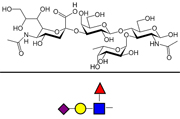
Sialyl Lewis X structure. Click here for a key to the symbols.
During anti-cancer therapy lymphomas infiltrate and engraft organs to escape cell death. Similar to events that occur in lymphocyte homing, E-selectin-glycan interactions allow lymphoma cells to escape from blood vessels as a precursor to infiltration. Endothelial E-selectin has been shown to interact with the sialyl-Lewis X (sLex) glycans present on PSGL-1 (P-selectin glycoprotein ligand-1), ESL-1 (E-selectin ligand-1), L-selectin and CD44. However, these ligands are not detectable in the highly infiltrative cancer B cell precursor acute lymphoblastic leukemia (BCP-ALL), which instead showed an upregulation of the sialoglycoprotein leukosialin (CD43). Now in Cancer Research, Nonomura et al. show that CD43 drives BCP-ALL tissue infiltration.
Nonomura et al. observed that BCP-ALL cell lines did not adhere to E-selectin when incubated with O-sialoglycoprotein endopeptidase (OSGPEPase). Immunoblotting indicated the presence of an sLex carrying protein, which was identified as CD43; the blotting signal disappeared after incubation with OSGPEPase. CD43 was confirmed as the sole BCP-ALL cell ligand for E-selectin by the fact that the lymphoma cell lines did not express PSGL-1, and that BCP-ALL clinical samples exhibited the CD43high PSGL-1low profile.
Nonomura et al. found that CD43 knockdown increased BCP-ALL cell blood vessel rolling velocity and decreased endothelial tethering in a cell adhesion assay. Spleen and liver infiltration by BCP-ALL cells was strongly reduced in vivo following CD43 knockdown in mice. Interestingly, no other cell surface protein known to regulate tissue engraftment showed signs of decrease, indicating that the presence of CD43 alone is sufficient for BCP-ALL tissue infiltration.
The results of Nonomura et al. add to initial reports that CD43 is a ligand for E-selectin on T cells where it cooperates with PSGL-1. However, the new findings suggest that CD43 is the only E-selectin ligand on BCP-ALL cells. Further analysis will determine CD43 presence on other lymphoma types and the composition of the CD43 sLex glycan epitope which can be modified by sulfation. Blocking CD43 may even be a potential therapeutic option to prevent lymphoma tissue infiltration.