Research Highlights
Glycan-lectin binding: The polyvalent value of viruses
Functional Glycomics (10 April 2008) | doi:10.1038/fg.2008.21Standfirst
Glycan ligands can be built onto virus particles in a polyvalent fashion, which enables their binding to lectin receptors.
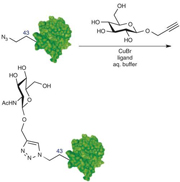
Mechanism of azide-alkyne cycloaddition. Click here for a full-size image. From van Kasteren, S.I. et al. Site-selective glycosylation of proteins: creating synthetic glycoproteins.
Nature Protocols 2, 3185 - 3194 (2007)
Lectins often bind to their ligands in a polyvalent fashion. Examples include the galectins and the Siglecs (sialic-acid-binding immunoglobulin-like lectins), among which Siglec-2 (CD22) is expressed on B cells and lymphomas. CD22 binds to  2,6-sialylated glycans, which also occur as terminal glycans on lymphocytes, so that sialosides on B cells can inhibit interactions with receptors on other cells. This inhibition can be overcome only when other ligands outcompete the cis ligand by polyvalent binding. The synthesis of biologically viable, polyvalent glycan ligand carriers has progressed with the introduction of gold nanoparticles. Now, in the Journal of the American Chemical Society, Kaltgrad et al. show how virus particles can be used as polyvalent ligand carriers for CD22.
The authors created a surface that promised biological viability and carried a chemically reactive linker for carbohydrates in a clustered fashion by expression of a virus capsid protein that incorporated the amino-acid homopropargyl glycine at defined positions. Alternatively, a short alkyne linker was attached to side-chain amino groups of lysines exposed on the capsid surface. Next, Kaltgrad et al. coupled the initial N-glycan carbohydrate N-acetylglucosamine (GlcNAc), galactosylated GlcNAc (LacNAc), and 2,6-sialylated LacNAc – the CD22 ligand – by azide-alkyne cycloaddition to the carrier's modified amino acids. Each of the glycosylated virus capsides showed distinct glycan receptor binding properties. Kaltgrad et al. also performed a chemoenzymatic synthesis of the ligand in which they used the synthesized GlcNAcylated viral capsid protein to conduct a 'one pot' synthesis of the glycosylated capside by glycosyltransferase enzymes.
When the authors tested the receptor-binding properties, the chemoenzymatically and the chemically synthesized sialoside virus capsids were almost identical in their binding properties to CD22 on beads and cells bearing their native sialoside ligands. Furthermore, they found that a 4-40 times higher incubation with the free sialoside was necessary to disrupt the interaction between the virus glycan and cells expressing CD22, which clearly illustrates the polyvalent nature of the CD22-virus sialoside interaction.
Taken together, virus capsids offer a platform to anchor glycan ligands in a way that mimics a polyvalent geometry required for lectin binding. This method may prove valuable in exploring glycan-binding effects and in inhibition studies.