Research Highlights
Tumor vaccination: C-lectin a new receptor
Functional Glycomics (10 July 2008) | doi:10.1038/fg.2008.32Standfirst
CD8 + dendritic cells are characterized by a novel C-lectin receptor termed DNGR-1, which is a promising candidate for tumor vaccination because of its endocytic behavior.
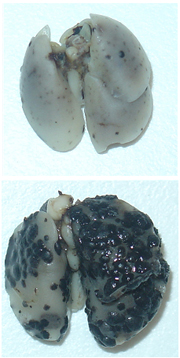
Lungs of mice challenged with melanoma cells and treated (top) or untreated (bottom) with the fusion antibody and adjuvant. Image by courtesy of Dr David Sancho-Madrid, Immunobiology Laboratory, London Research Institute, Cancer Research UK.
The dendritic cell lectin receptor DC-SIGN (dendritic cell (DC)-specific intercellular adhesion molecule 3 grabbing nonintegrin) is involved in human immunodeficiency virus infection and has been used for attempts in cancer tumor therapy. Now, in the Journal of Clinical Investigation, Sancho et al. characterize a new DC lectin receptor with promising therapeutic potential.
Mouse CD8+ DCs, in contrast to CD8- DCs, cross-present exogenous antigens on major histocompatibility complex class I molecules. Thus, tumor-derived antigens bound by CD8+ cells can elicit a strong cytolytic (CTL) T-cell response against the tumor. Screening gene expression data, the authors discovered a receptor discerning CD8+ from CD8- cells termed DNGR-1 (DC, natural killer (NK) lectin group receptor-1) owing to its structural relatedness to receptors such as dectin-1, which occurs on NK cells. Flow cytometry indicated that DNGR-1 solely occurs on CD8+ cells, suggesting that it is a defining feature of them.
Sancho et al. noted that a fluorescence-labeled antibody against DNGR-1 was readily endocytosed into the DCs. This prompted them to fuse an anti-DNGR antibody with the immunodominant peptide of the chicken ovalbumin antigen. When the authors injected the fusion antibody and an adjuvant into mice, antigen-specific CTL T cells were expanded and activated, indicating a potential of DNGR-1 for tumor immunotherapy. Indeed, mice vaccinated with the same fusion-adjuvant combination developed much fewer metastases when challenged with melanoma cells expressing the ovalbumin antigen. Lastly, the authors — and researchers in an independent study — found that DNGR-1 is also expressed on human immune cells where it has a similar specificity for a subgroup of DCs.
The results of the presented study are remarkable in the characterization of a novel lectin receptor that defines a subset of DCs able to induce a CTL T-cell response. It will be interesting to know whether glycan ligands for DNGR-1 have the potential to increase the immune response.