Research Highlights
Glycopharmacology: New directions
Functional Glycomics (11 September 2008) | doi:10.1038/fg.2008.41Standfirst
Two new publications show new directions for glycopharmacology in HIV infection and cancer treatment, and in a third publication Surfen reveals a broad spectrum of effects by binding to heparan sulfate.
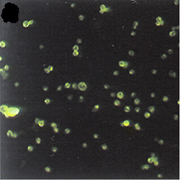
Binding of a CD4-derived glycopeptide to chronically HIV-infected ACH2 cells. From Perdomo M. F. et al. Neutralization of HIV-1 by redirection of natural antibodies. PNAS 105, 12515 – 12520 (2008) © 2008 National Academy of Sciences, U.S.A.
Based on the growing knowledge about glycan function, an increasing number of publications reports promising results for clinical applications of glycobiology. Three articles published in the Proceedings of the National Academy of Sciences of the USA (PNAS) now propose new approaches in several areas of drug discovery.
All mammals, except humans, carry the galactose- 1,3-galactose (-Gal) glycoepitope. This feature makes cross-species transplantations impossible, as humans possess a high titer of antibodies against the epitope. Perdomo et al. harnessed this fact for a new immunotherapeutic approach against HIV (human immunodeficiency virus) infection. HIV fuses with CD4+ T-helper cells when the gp120 envelope protein docks to the CD4 receptor. However, gp120 is a difficult target for drug discovery owing to its high variability and abundant glycosylation. Perdomo et al. synthesized -Gal-glycosylated peptides mapping the HIV-binding portion of CD4, and screened their potential to redirect natural human anti--Gal antibodies to gp120-binding CD4 peptides. In one assay, HIV-infected ACH2 lymphocytes underwent cytolysis when incubated with the glycopeptides and natural killer cells in the presence of human serum. This indicates that the -Gal glycoepitope, attached to gp120 on the ACH2 cells through the CD4 peptides, redirected natural serum antibodies, which led to natural-killer-cell binding and subsequent cytolysis. Several more assays showed the HIV-neutralizing properties of the CD4 glycopeptidesby redirecting serum antibodies.
The Globo-H (globohexaosylceramide) hexasaccharide has been proposed as a unique glycan signature of cancer stem cells; moreover, its expression on normal cells is very low or non-existent. Chang et al. isolated breast cancer cells positive for stem-cell markers by flow cytometry and monitored Globo-H presence.
On average, breast-cancer stem cells (BCSCs) from 20% of the breast cancer samples were positive for Globo H, compared with 60% for cancer cells not expressing stem-cell markers. In contrast, the pentasaccharide SSEA3 (stage-specific embryonic antigen-3), which undergoes fucosylation to form Globo H, was present on BCSCs from more than 60% of the tumors and on cells not carrying stem-cell markers from 80% of the tumors. SSEA3 expression was negligible in normal tissues, and mice injected with an existing Globo-H/keyhole limpet hemocyanin conjugate developed high counts of anti-Globo-H and anti-SSEA3 antibodies. Thus, the SSEA3 glycoepitope might present an even more promising target for cancer immunotherapy than GLOBO-H.
After noting that Surfen, a quinoline derivative of low molecular mass, binds strongly to heparan sulfate and heparin, Schuksz et al. screened its potential to modulate the effects of heparan sulfate. Heparan sulfate proteoglycans (HSPGs) modulate numerous ligand–receptor interactions and the subsequent signaling pathways such as fibroblast growth factor (FGF) signaling. Surfen reduced FGF-/vascular endothelial growth factor-dependent vessel formation of mouse lung endothelial cells. This indicates that binding of Surfen to heparan sulfate inhibits FGF signaling by blocking FGF/HSPG complex formation.
Heparin, a highly sulfated heparan sulfate, is often used in anticoagulation therapy. Monitoring heparin anticoagulation activity in vitro, Surfen was found to inhibit heparin with a similar effectivity as protamine, suggesting that it might be a less toxic alternative to protamine. Finally, cell attachment and infection by herpes simplex virus — which requires heparan sulfate — was strongly diminished when Surfen was added. Future studies may elucidate the mechanism by which Surfen interacts with heparan sulfate to accomplish these effects, and in vivo studies might reveal the full pharmacological potential of Surfen and its derivatives.