Featured Articles
Bacterial glycans and mammalian lectins: A precarious balance
Functional Glycomics (09 October 2008) | doi:10.1038/fg.2008.43Standfirst
Gram-negative bacterial lipopolysaccharide (LPS) upregulates the soluble lectin RegIII which kills gram-positive bacteria in the intestines, whereas LPS-induced sepsis can be averted by the lectin-like domain of thrombomodulin.
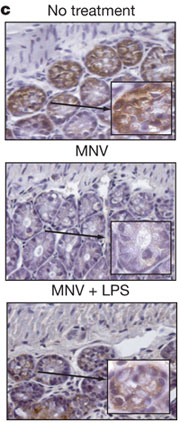
Immunohistochemical detection of RegIII (brown) in sections of small intestine from untreated mice, mice receiving the antibiotic cocktail MNV, and mice receiving MNV plus LPS. From Brandl, K. et al.; click here for the original image. © 2008 Nature Publishing Group.
Peptidoglycan and LPS are important carbohydrate-containing antigens produced by gram-positive and gram–negative bacteria. Two publications now show that LPS and peptidoglycan are targets for two mammalian lectins to defend the body against bacterial infections.
High levels of gram-negative LPS overstimulates Toll-like receptor 4 (Tlr4) signaling and causes septic shock. Moreover, mice lacking the N-terminal lectin-like domain of the large transmembrane glycoprotein thrombomodulin (TMD1) are prone to sepsis. Published in Blood, Shi et al. used a cell culture assay to show that  -recombinant TMD1 (rTMD1) inhibits the LPS-induced production of the inflammatory cytokine tumor necrosis factor (TNF-). They also show that binding of rTMD1 to LPS blocks inflammatory pathways.
Shi et al. investigated whether rTMD1 attenuates sepsis in vivo and observed that there was a 50% survival rate for mice injected with rTMD1 prior to injection of LPS or gram-negative Klebsiella pneumonia, whereas all mice receiving only LPS or bacteria died. The blood of mice receiving rTMD1 was found to be clear of bacteria. Cell assays showed that rTMD1 bound directly to the LPS on the bacterial membrane, followed by agglutination and phagocytosis of the pathogens. Shi et al. performed a ligand screen and discovered that the tetrasaccharide Lewis Y, but not the other Lewis glycans, specifically inhibited the rTMD1–LPS interaction. Thus, rTMD1 binds to the difucosylated Lewis Y glycan epitope of LPS, leading to bacterial agglutination, clearance and the blocking of inflammation. These results suggest that rTMD1 may be a potential candidate for the treatment of gram-negative bacterial infection, as well as encouraging further research into the role of thrombomodulin in infectious diseases.
Research by Brandl et al. published in Nature shows that, despite the dangerous effects of systemically administered LPS, it may also support anti-bacterial action against gram-positive bacteria in the gut. Brandl et al. noted that gram-positive vancomycin-resistant enterococci (VRE) were cleared from the intestines of mice that had orally received LPS together with a mixture of three antibiotics including vancomycin. In contrast, treatment with antibiotics alone led to a strong proliferation of VRE.
Previous research had shown that the soluble lectin RegIII binds to peptidoglycan, thereby killing gram-positive bacteria such as VRE. Therefore, Brandl et al. looked at RegIII expression in the ileum and found that it slumped when mice were treated with the antibiotic cocktail alone, whereas it reverted almost to normal levels with the addition of LPS to the cocktail. The authors analyzed Tlr4-Myd88 (myeloid differentiation primary response gene 88) signaling as the main transducer of LPS effects, and found that RegIII expression upon exposure to LPS was considerably lower in Myd88-deficient mice than in wild-type mice. These results indicate that intestinal gram-negative bacteria engage Tlr4-Myd88 signaling through LPS, subsequently upregulating RegIII expression and aiding the destruction of peptidoglycan-exposing gram-positive bacteria.
Both studies provide insight into the delicate interplay between bacterial carbohydrate antigens and mammalian lectins that balances the gut's populations of commensal bacteria and clears invading bacteria from the blood.