Research Highlights
Tumor progression: A sweet sword promotes cell invasion
Functional Glycomics (09 October 2008) | doi:10.1038/fg.2008.45Standfirst
Low-molecular weight chondroitin sulfate molecules in the extracellular matrix promote metalloprotease-mediated cleavage of CD44's extracellular domain, thereby promoting the invasion of tumors into the surrounding tissue.
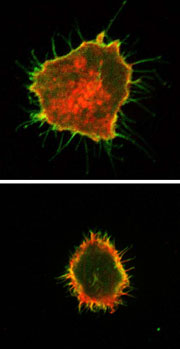
Filopodia formation and spreading of pancreatic cancer cells treated with 3 kDa CSE (top); bottom: cells treated with 75 kDa CSE. Images by courtesy of Dr Kazuki N. Sugahara, Vascular Mapping Center, Burnham Institute for Medical Research at University of California Santa Barbara.
Tumor cells invade their surrounding tissue and degrade the extracellular matrix (ECM) glycosaminoglycan component hyaluronan. These hyaluronan fragments then induce the cleavage of CD44's extracellular domain by metalloproteases. This leads to both the translocation of the intracellular domain of CD44 to the nucleus and the transcription of genes — including CD44 — that support tumor progression. Reporting to Cancer Research, Sugahara et al. set out to investigate whether specific forms of chondroitin sulfate, another ECM glycosaminoglycan component, also contribute to tumor cell invasion.
The glycosaminoglycan chondroitin sulfate type E (CSE) consists of repeating units of disulfated N-acetylgalactosamine linked to glucuronic acid and is known to bind to the cell motility regulators selectin and CD44. Using a novel CSE-specific antibody, Sugahara et al. detected CSE in mutant mice with spontanous pancreatic cancer as well as in tumors induced by the injection of human pancreatic cancer cells.
When migrating pancreatic cancer cells were incubated with CSE, the authors observed that the extracellular domain of CD44 was cleaved only in the presence of low-molecular weight fractions of CSE that had been extracted from mice tumors. Replicating the hyaluronan-CD44 interaction, low-molecular weight CSE also dramatically enhanced CD44-dependent tumor cell motility. A synthetic low-molecular weight CSE produced similar results, which were abolished upon treatment with chondroitinase or a CD44-neutralizing antibody. These findings identify CSE as a novel component of the tumor microenvironment and indicate that CSE fragments promote tumor motility by cleaving CD44 in a manner similar to that of hyaluronan fragments. Whether CSE is generated by tumor metalloproteases or other unknown mammalian chondroitinases remains to be determined.
This study adds to our knowledge about the way that molecules from the tumor cell microenvironment interact with proteins on the cancer cell surface in cancerogenesis. Future studies may show whether blocking the interaction between glycosaminoglycans and cancer cell proteins can abrogate tumor progression.