Featured Articles
Cell differentiation and motility: Galectin-1 gives them a go!
Functional Glycomics (13 November 2008) | doi:10.1038/fg.2008.47Standfirst
The carbohydrate binding protein galectin-1 increases glioblastoma cell motility and promotes B-cell differentiation by binding to cell surface glycoproteins.
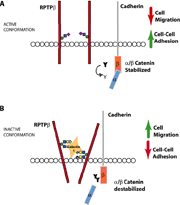
Working model for the inhibition of RPTP activity and subsequent increases in -catenin phosphorylation by GnT-Vb-mediated glycosylation and galectin-1 binding. © 2008 by the American Society for Biochemistry and Molecular Biology.
Extracellular galectin-1 (Gal-1) regulates many signalling events by binding to galactoside epitopes on glycoproteins, with profound consequences for cellular development. Two new studies now give insight into the range of effects that carbohydrate–galectin-1 interactions have on cellular development.
The receptor tyrosine phosphatase (RPTP) dephosphorylates -catenin, decreasing the -catenin/cadherin interaction and leading to reduced cell adhesion and increased migration of both cancer and neural cells. The trisaccharide HNK-1 (human natural killer-1, also known as CD57) consists of a sulfated glucuronic acid linked to N-acetyllactosamine (LacNAc) and plays a role in neuronal development. Published in the Journal of Biological Chemistry, Abbott et al. have discovered that glioblastomal RPTP carries HNK-1, which is synthesized by Gn-TVb. The authors investigated whether the presence of HNK-1 alters RPTP activity as an earlier study of theirs showed that a lack of Gn-TVb decreases migration of SY5Y neuroblastoma cells. They found that SY5Y cells expressing GnT-Vb had a 40% increase in phosphorylated -catenin, whereas a GnT-Vb knock-down led to a 20% decrease compared to control cells. Furthermore, cells expressing GnT-Vb showed a strong increase in the formation of inactive RPTP dimers, pointing to a link between the presence of HNK-1 and RPTP activity.
Abbott et al. conducted a screen for galectins that might bind to HNK-1 and discovered that RPTP and Gal-1 co-immunoprecipitated. They also found that there was an increased presence of Gal-1 on the glioblastomal cells concomitant with RPTP expression. These results indicate that RPTP dimerization — which is caused by binding of Gal-1 to HNK-1 — eliminates its ability to de-phosphorylate -catenin, thus increasing cell motility. The pivotal role of the Gal-1–HNK-1 interaction was also underscored by the observation that cells incubated with LacNAc displayed an inhibition in binding between Gal-1 and RPTP. Thus, in neuroblastomal cells, Gal-1 fulfils a similar task for RPTP as it does for CD45 phosphatase in T cells — it crosslinks protein monomers to create dimers that, in turn attenuate phosphatase activity.
As a role for Gal-1 in T-cell development is well established, Tsai et al. considered whether Gal-1 also plays a role in B-cell differentiation. Reporting to the Journal of Immunology, the authors first showed that Blimp-1 — a main driver of B-cell differentiation — also controlled Gal-1 expression. Next, more IgM-secreting B cells were found when Gal-1 was ectopicly expressed or when cells were incubated with low doses of lipopolysaccharide, suggesting a role for Gal-1 in B-cell differentiation.
A mutant Gal-1 unable to either bind -galatosides or be exported from the cell did not lead to increased immunoglobulin production in leukemic and splenic B cells. Moreover, incubation of the cells with a fluorescently labeled Gal-1 construct uncovered that the protein directly bound to the cell surface. Lastly, LacNAc incubation inhibited the effects of Gal-1 in a dose-dependent manner, leading Tsai et al. to conclude that Gal-1 promotes B-cell immunoglobulin production by binding to cell surface glycans rather than by interfering with intracellular signal pathways.
Because Gal-1 preferentially binds to mature B cells, the authors speculate that these cells must strongly express the glycan epitopes that bind Gal-1. Taken together, the results of Tsai et al. indicate that Gal-1 influences B-cell development in a similar manner to that of T-cell development.