Featured Articles
Developmental glycosylation: A small sugar
Functional Glycomics (13 November 2008) | doi:10.1038/fg.2008.48Standfirst
Fucosylation by the protein O-fucosyltransferase 1 (Pofut1) is required for the development of the enteric nervous system in mice, but blocks acetylcholine receptor clustering on skeletal muscles.
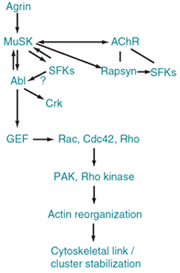
Signalling steps in the Agrin/MuSK pathway that lead to AChR clustering and stabilization at the neuromuscular junction.
In many organisms developmental processes are regulated by the fucosylation of epidermal growth factor (EGF) repeats of cell surface proteins such as the Notch receptor. Whereas the basic mechanism and effects of protein O-fucosyltransferase 1 (Pofut1) activity have been elucidated for Drosophila embryonic development, the consequences and mechanisms of fucosylation in mammalian species remain elusive.
As Notch signaling is required for the maintenance of neural stem cells, Okamura and Saga, writing in Development, set out to analyze the effects of disrupting Pofut1 in the neural crest cells (NCCs) of mouse embryos (Pofut1 cKOs). Mutant mice, although morphologically normal, died one day after birth. A lack of milk in the stomach of Pofut1 cKOs pointed to defects in the development of the enteric nervous system (ENS). Indeed, as well as ENS ganglion structure disruption, Okamura and Saga also registered a lower count of enteric neural crest cells (ENCCs) — a type of NCC that forms the ENS — that was not due to increased apoptosis.
Instead, the authors hypothesized that the Pofut1 knockdown interfered with ENCC stem cell maintenance by altering Notch signaling. ENCCs lose their stem cell status and differentiate into neural cells when the SOX10 transcription factor becomes inactive as a result of Mash1 expression, which in turn is repressed by Notch signaling. Indeed, more ENCCs from Pofut1 cKOs developed into neural cells, and there were more Mash1 single-positive cells than SOX10 single-positive cells among the ENCC population. The authors conclude that a lack of Notch fucosylation by Pofut1 shifts the balance from SOX10 single-positive towards Mash1 single-positive cells, leading to premature neurogenesis and reduced ENCC maintenance and proliferation.
Fucosylation by Pofut1 appears to not only be important for receptor functionality. According to results reported by Kim et al. in Molecular and Cellular Neuroscience, it also influences the aggregation of cell surface protein complexes and is dynamically regulated during development. Acetylcholine receptors (AChR) cluster together at the neuromuscular junction in order to transduce excitatory signals. The active splice variant of the extracellular matrix protein agrin (z8 agrin) stimulates AChR clustering, whereas the z0 agrin splice variant, which is present in skeletal muscle and other tissues, has been shown to lack the clustering ability of neuronal z8 agrin. However, when Kim et al. expressed agrin in cells with low or high Pofut1 activity they found that only high fucosyltransferase activity eliminated z0 agrin-induced clustering of AChR on mouse muscle cells, whereas low fucosylation led to receptor clustering. Indeed, mutation of a z0 agrin O-fucosylation consensus site also restored its aggregation function in clustering assays. These findings suggest that fucosylation by Pofut1 is required to eliminate clustering of AChRs in skeletal cells.
Similarly, AChR cluster formation was also present in vivo in mouse myofibers that had undergone conditional Pofut1 knockout. Performing gene expression analysis of embryonic skeletal muscle development, Kim et al. found that by embryonic day 15.5 Pofut1 expression had slumped by 75% relative to agrin expression, whereas it was 20-30% before and after birth. Thus, fucosylation by Pofut1 may prevent AChR clustering on skeletal muscle fibers, except on day 15.5 when AChR normally aggregates along regions of skeletal myofibers outside the neuromuscular junction. As Pofut1 expression in the brain followed a different time course, these results indicate that fucosylation by Pofut1 follows a tissue-specific schedule, such as in skeletal muscles where it may negatively regulate AChR clustering by agrin.