Featured Articles
Tissue development: Cleaving an acidic sugar promotes differentiation
Functional Glycomics (15 January 2009) | doi:10.1038/fg.2009.2Standfirst
Silencing glycolipid desialylation on muscle progenitor cells abrogates differentiation into muscle fibers and promotes apoptosis.
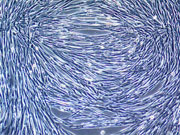
Human skeletal myoblast in vitro culture. Image taken from Haider H., Molecular Therapy9, 14–23 (2004)
Receptor-ligand interactions can be regulated by transmembrane sialidases, which cleave sialic acids from cell surface glycans. The NEU3 sialidase cleaves sialic acids that terminate ganglioside glycolipids and has been shown to reduce apoptosis of cancer cells and lymphocytes. Now, in the Journal of Biological Chemistry, Anastasia et al. investigate the role of the NEU3 in skeletal myoblasts, which differentiate into myocytes and fuse into myotubes to form muscle fibers.
The authors silenced NEU3 expression in C2C12 mouse myoblasts using short hairpin RNAs (iNEU3 cells). They found that wild-type cells, but not iNEU3 cells, formed myotubes when treated with a differentiation agent, showing that NEU3 regulates myoblast differentiation. This finding was supported by significantly increased NEU3 expression in wild-type cells at the end of the differentiation process. Immunofluorescence studies revealed the presence of apoptotic markers — such as caspase 3/7 expression and DNA degradation — in iNEU3 cells but not in wild-type C2C12 cells, suggesting NEU3 also protects myoblasts from apoptosis.
NEU3 silencing shifted the range of glycolipids present on the cells to predominantly sialylated GM3. Importantly, NEU3 silencing caused the inhibition of epidermal growth factor receptor (EGFR) and decreased its expression, which was restored upon inhibition of ganglioside synthesis. This observation led the authors to suggest that desialylated ganglioside structures enhance EGFR membrane localization and function.
Anastasia et al. observed that overexpression of EGFR in iNEU3 cells partially restored their differentiation potential. Furthermore, iNEU3 cells regained their ability to differentiate into myocytes when they were co-cultured with wild-type C2C12 cells. Thus, the presence of NEU3 activity from adjacent wild-type C2C12 cells was sufficient to compensate for the loss of the sialidase in iNEU3 cells.
Together, these results show that NEU3 activity is required for EGFR function and is crucial for myoblast differentiation. Interestingly, the results of an independent study by Gadhoum and Sackstein published in Nature Chemical Biology show that desialylation of sialyl-Lewis X on myeloid cells is required for their differentiation. There is increasing evidence that cell surface sialidases alter glycan composition and regulate receptor-ligand interactions on the cell surface.