Research Highlights
Epileptic seizures: Sugars-coated leukocytes get roped in
Functional Glycomics (15 January 2009) | doi:10.1038/fg.2009.3Standfirst
Inhibition of P-selectin glycoprotein ligand-1 (PSGL-1) and other leukocyte adhesion molecules impairs leukocyte-endothelial cell interactions, dampens blood-brain barrier leakage and prevents seizures in mice.
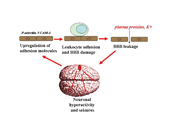
Image courtesy of Dr. Paolo Fabene, Department of Morphological-Biomedical Sciences, Verona, Italy.
Inflammation triggers the upregulation of P-selectin, a glycan-binding protein on the surface of endothelial cells. P-selectin binds to PSGL-1 expressed on leukocytes passing by in the bloodstream and tethers them to the endothelium. This loose attachment gives endothelial cell adhesion molecules, such as ICAM-1 and VCAM-1, the chance to strengthen the leukocyte–endothelium relationship by binding integrins on the leukocyte surface. Ultimately, these connections allow leukocytes to exit the blood vessel into surrounding tissues in a process known as extravasation. Leukocyte extravasation is necessary to fight infection; however, too much inflammation can disrupt the blood-brain barrier (BBB). Inflammation and disruption of the BBB are increasingly implicated in seizures and the development of epilepsy. Now, reporting in Nature Medicine, Fabene et al. show that leukocyte–endothelial cell interactions occur more frequently in epileptics and that epileptic seizures can be prevented or treated by blocking contact.
To define the role of leukocytes in the pathogenesis of epilepsy, Fabene et al. induced spontaneous recurrent seizures in mice. They found that seizures stimulated expression of the endothelial cell adhesion molecules ICAM-1 and VCAM-1 and enhanced adherence of leukocytes to BBB blood vessels, thus linking inflammatory changes in the BBB vasculature with the development of epilepsy.
Next, the authors investigated whether blocking the connection between leukocyte glycoproteins and endothelial cell adhesion molecules could prevent or treat seizures. Antibodies directed against  4 integrin, VCAM-1, PSGL-1 or P-selectin markedly reduced the number of leukocytes rolling along or stuck to endothelial cells. More strikingly, mice treated with anti-4 integrin antibody experienced significantly fewer convulsions than untreated epileptic mice and treatment before chemical induction of seizures prevented convulsions completely. Even mice lacking PSGL-1 were less likely to develop epilepsy than wild-type mice, and those that did go on to develop the disease experienced fewer convulsions. Likewise, seizures were ameliorated in mice lacking 1,3-fucosyltransferases, which are required for the addition of certain sugars to the PSGL-1 protein. Without these residues, P-selectin could not recognize PSGL-1 and leukocyte–endothelial cell interactions were impaired, indicating that leukocyte adhesion plays an integral part in the pathogenesis of epilepsy.
Epilepsy is currently treated with surgery, nerve stimulation and medications that target ion channels in the brain. However, these therapies are not always effective because the cause of seizures is often unknown and can vary from patient to patient. This study takes an alternative approach by demonstrating that inhibition of inflammation and preservation of the BBB might be used to treat, and even prevent, seizure disorders.