Research Highlights
Neurons: Sugar-free cells cannot compete
Functional Glycomics (15 January 2009) | doi:10.1038/fg.2009.4Standfirst
Activation of the immunoglobulin superfamily member L1 triggers neuron glycosylation and promotes neurite outgrowth, migration and survival.
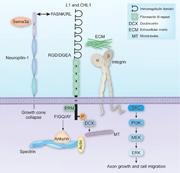
Signaling pathways downstream of L1 and CHL1. Image taken from Maness F. P. & Schachner M. Nature Neuroscience10, 19–26 (2007).
Glycosylation patterns differ by cell type and developmental stage. Fucose and sialic acid are required for many biological processes, such as inflammation and development. As defects in glycosylation are associated with tumor metastasis and neurological disorders, studies of how glycosylation is regulated are necessary to appreciate how glycans and glycan-binding proteins influence cell–cell communication in both normal and healthy states. In PLoS One, Li et al. show how the cell adhesion molecule L1 — which is involved in neuronal development and regeneration — functions during neuronal sialylation and fucosylation.
L1 is a glycan-binding protein that specifically recognizes 2,3-linked sialic acids and is itself glycosylated. To explore the hypothesis that L1 alters glycosylation patterns at the neuronal cell surface, Li et al. compared carbohydrates expressed by wild-type neurons and neurons derived from knockout mice lacking L1. They found that both sialic acid and fucose expression were downregulated in L1-deficient neurons. Furthermore, treatment of L1-expressing cells with an anti-L1 antibody, which mimics the trans-interaction between L1 molecules expressed on different cells, increased expression of sialic acid and fucose. Thus, activation through L1–L1 interaction, at least in part, regulates sialylation and fucosylation at the neuronal cell surface. Further experiments revealed that activated L1 stimulates expression of the glycosyltransferases fucosyltransferase 9 (Fut9) and  -galactoside-
 2,6-sialyltransferase (ST6Gal1) via the phospholipase C
 /Erk signaling pathway.
L1-mediated glycosylation has extensive biological consequences. Upon activation, neurons lacking L1 failed to form neurite outgrowths. Neuron migration and survival were also reduced in the absence of L1. Knockdown of Fut9 and ST6Gal1 had similar effects, suggesting that modulation of glycosylation by L1 is responsible for changes in neuron behavior.
This study provides valuable insight into the cell signaling pathways that influence neuronal glycosylation. As alterations in glycosylation can dramatically affect the development and functioning of the central nervous system, an increased understanding of the mechanisms that regulate glycosylation will aid the development of new carbohydrate-directed therapeutics.