Featured Articles
Protein folding: Sweet signals for degradation
Functional Glycomics (12 February 2009) | doi:10.1038/fg.2009.5Standfirst
The Man7GlcNAc2 sugar is produced by the Htm1p protein and functions as a flag for misfolded glycoproteins, which are recognised by the Yos9p lectin and targeted for degradation.
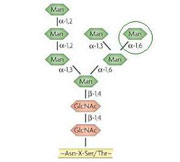
Proteins entering the endoplasmic reticulum (ER) are decorated with chains of sugars that help them to fold in the ER lumen. Sugar chains improve the water solubility of proteins, but also, importantly, they serve as tags for proteins that modulate folding. When folded correctly and integrated into the right complexes, proteins continue along the secretory pathway to reach their site of action. In contrast, misfolded glycoproteins are retained in the ER and targeted for degradation in a process that involves retrotranslocation to the cytoplasm and hydrolysis by the 26S proteasome. Man8GlcNAc2 was thought to be the glycan that marked misfolded proteins for degradation. However, two studies now show that the degradation signal is instead the slightly different Man7GlcNAc2 sugar.
The first protein glycosylation step in the ER is the transfer of a preassembled Glc3Man9GlcNAc2 oligosaccharide. This initial glycan is then trimmed by the sequential action of glucosidase I, glucosidase II and mannosidase I, with the end product being Man8GlcNAc2. Proteins gradually fold during these glycan trimming steps. Mannosidase I is a slow-acting enzyme and it has been suggested that when Man8GlcNAc2 is present on misfolded proteins that take too long to fold, it serves as a signal for degradation.
Htm1p and its homologues have been proposed to act as ER lectins that recognise Man8GlcNAc2 and target proteins for degradation. As reported in Journal of Cell Biology, Markus Aebi and colleagues further assessed the function of Htm1p in yeast. By overexpressing HTM1 and studying glycan processing kinetics and composition, the authors demonstrate that Htm1p functions to trim one mannose ring from Man8GlcNAc2 to generate Man7GlcNAc2. Furthermore, they show that Man7GlcNAc2, which is characterised by a terminal  1,6-linked mannose, is recognised by the putative ER-degradation lectin Yos9p.
In another study published in Molecular Cell, Jonathan Weissman and colleagues report that Yos9p specifically binds to 1,6-linked mannose residues. The authors also demonstrate that 1,6-linked mannose-containing oligosaccharides are required for protein degradation in vivo and that Htm1p functions upstream of Yos9p.
Together these studies demonstrate that protein quality control in the ER requires the activity of two proteins: Htm1p – which produces the signal that triggers the degradation process, and Yos9p – which recognises the signal. Furthermore, they assign a previously unreported mannosidase activity to Htm1p and identify Man7GlcNAc2 as the degradation signal. However, an intriguing question remains as to how Htm1p selects its substrates.