Research Highlights
N-glycan biosynthesis: Flipping for precursors
Functional Glycomics (12 February 2009) | doi:10.1038/fg.2009.7Standfirst
A specific enzyme named flippase translocates the precursor of all N-glycans from the cytoplasmic face to the lumen of the endoplasmic reticulum (ER).
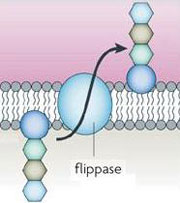
The oligosaccharide portion of N-glycoproteins is assembled on dolichol phosphate — an isoprenoid lipid — and then transferred to proteins in the lumen of the ER by oligosaccharyltransferases. Assembly of the dolichol-linked oligosaccharide (DLO) occurs step-wise. Seven sugars (two N-acetylglucosamines and five mannoses) are added to the lipid on the cytoplasmic face of the ER to generate Man5GlcNAc2-PP-dolichol (M5-DLO). M5-DLO then flips across the ER membrane to face the lumen where seven more sugars (four mannoses and three glucoses) are added to generate the N-glycan precursor glycolipid. Since the hydrophobic nature of the ER lipid bilayer presents a considerable barrier to relocation of the hydrophilic M5-DLO, it has long been presumed that some unknown flippase or chaperone must be responsible. In a study appearing in Proceedings of the National Academy of Sciences, Sanyal and Menon now reconstitute the transport activity and reveal that the flippase is highly specific for M5-DLO.
In order to test the rate and specificity of flipping, the authors used a lectin to detect M5-DLO that translocates from the inside of proteoliposomes to the outside. In this system, 100% of M5-DLO in proteoliposomes containing flippase activity was detected on the outside, whereas only 50% of M5-DLO was captured from proteoliposomes without flippase. However, the question remained as to whether this flippase activity is specific to M5-DLO or is the same that transports glycerophospholipids into the ER. By separating ER-membrane proteins into fractions and reconstituting them into proteoliposomes, the authors found that glycerophospholipid flippase activity occurs independently of M5-DLO flipping, indicating that this N-glycan intermediate must use its own flippase.
To determine if this flippase could translocate any dolichol-linked oligosaccharide, the authors tested other intermediates in the DLO biosynthetic pathway and unnatural structures from yeast glycosylation mutants. M3-DLO, which contains two fewer mannose residues than M5-DLO, flipped almost as efficiently as M5, but higher order glycans such as M7, M9 or G2M9, were translocated at a much slower rate, if at all. Thus, flippase activity is highly selective for M5-DLO.
Sanyal and Menon propose that a flippase located in the ER lipid bilayer contains a binding site that specifically recognizes the dolichol-linked core structure of N-glycan precursors (M3). While this flippase can also bind smaller dolichol-linked oligosaccharides, structures more complicated than M5 are either excluded from the binding site altogether or their translocation is hampered by excess sugar residues exposed to the hydrophobic interior of the bilayer. This study provides a first glimpse into the mechanism of glycolipid flipping from one side of the ER membrane to the other, a crucial step in N-glycan biosynthesis.