Featured Articles
Lung metastasis: Novel carbohydrate receptors open the door
Functional Glycomics (12 March 2009) | doi:10.1038/fg.2009.10Standfirst
Sfrs proteins expressed on mouse lung capillaries bind cancer-associated carbohydrates and permit lung metastasis
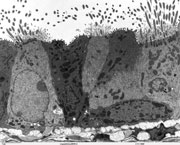
Transmission electron microscope image of a thin section cut through the bronchiolar epithelium of the lung (mouse)
Cancer cells display altered carbohydrate profiles, correlating with poor prognosis and increased metastasis. Cancer-associated carbohydrate antigens include the E-selectin ligand sialyl Lewis X. Whilst E-selectin promotes growth of established metastatic colonies, initial sialyl Lewis X-dependent lung colonization by melanoma cells is mediated by a separate, previously unidentified receptor. Now in PNAS, Fukuda and colleagues have identified a novel role for Sfrs alternative mRNA splicing factors as receptors for fucosylated carbohydrates, responsible for carbohydrate-dependent cancer cell colonization of the lung in mice.
The addition of fucose is a common oligosaccharide modification that is often increased in cancer. Expression of the fucosylated tetrasaccharide sialyl Lewis X dramatically increases metastatic capability of mouse B16 melanoma cells. Lung colonization by these cells is inhibited by a peptide mimic of E-selectin carbohydrate ligand (I-peptide), but neither E- nor P-selectin expression is necessary for metastasis. Fukuda and colleagues have now identified the I-peptide receptor; blood vessel surface proteins in live mouse were biotinylated and those that bound I-peptide-displaying phage (I-phage) subsequently identified by immunoprecipitation and proteomic analysis. Surprisingly, several Sfrs proteins were identified as binding I-peptide. Sfrs proteins are Ser/Arg-rich alternative mRNA splicing factors that localize to the cytoplasm and nucleus. The authors used immunohistochemistry to reveal that a subset of mouse lung capillaries also express Sfrs proteins on their luminal cell surface. Recombinant Sfrs1 was found to bind to sialyl Lewis X-transfected B16 melanoma cells (B16-FTIII-M cells), and this binding was inhibited by I-peptide. The carbohydrate-binding activity of Sfrs1 was investigated with glycan array analysis, revealing specificity for a series of fucosylated oligosaccharides.
Studies in vivo further strengthened the hypothesis that Sfrs proteins mediate carbohydrate-dependent lung metastasis. Intravenous injection of antibodies to Sfrs prevented lung targeting of I-phage and completely blocked lung colonization of B16-FTIII-M cells. The Sfrs-expressing lung endothelial cells were targeted for apoptosis with I-peptide-displaying liposomes, one day ahead of injection with B16-FTIII-M cells. Two weeks later the specific loss of these cells translated to a significant decrease in melanoma foci in lungs of the cancer-cell-injected mice.
The structural basis for Sfrs protein binding to fucosylated oligosaccharides is currently unknown, but their expression in lung provides an entrance for cancer cells expressing highly fucosylated carbohydrates on their surface to establish new metastases. Thus, surface expression of Sfrs proteins may be a viable target of anti-cancer therapy, in addition to current strategies attempting to target fucosylated antigens.