Research Highlights
Molecular mimicry: Sugar coating bacterial infection
Functional Glycomics (12 March 2009) | doi:10.1038/fg.2009.11Standfirst
Group B Streptococcus (GBS) has a sialic acid capsule that outcompetes host sialic acid in binding to neutrophil Siglec-9, thereby tempering the host response to infection and promoting bacterial survival.
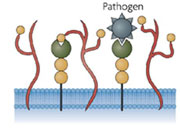
When Siglecs are masked by cis interactions with sialylated glycoproteins, trans interactions might occur during an encounter with another cell or a pathogen expressing higher affinity ligands that can out-compete the cis interactions
Sialic-acid-binding immunoglobulin (Ig)-like lectins (siglecs) are predominantly expressed on the surface of hematopoietic and immunological cells. Siglecs have an extracellular Ig domain that binds ligands expressing sialic acid. Similar to other CD33-related Siglecs, Siglec-9 also contains an immunoreceptor tyrosine-based inhibitory motif (ITIM) and an ITIM-like motif. These motifs are thought to reduce inflammatory responses by inhibiting cellular activation and proliferation when Siglecs bind "self" sialoglycans. In Blood, Carlin et al. reveal that sialic-acid-expressing GBS also binds Siglec-9 present on host neutrophils, thus ameliorating the innate immune response and allowing the bacterium to evade clearance.
Neutrophils are able to recognize "self" sialic acids expressed on the same cell through cis interactions. The authors determined that neutrophils can also bind exogenous sialic acid in trans in a Siglec-9-dependent manner. Indeed, Carline et al. found that Siglec-9-sialoglycan interactions in trans outcompeted the binding of cis sialic acids in experiments using polyacrylamide arrays bearing either synthetic sialoglycans or purified sialylated GBS capsular polysaccharide.
Functionally, the consequences of the interaction between the sialylated GBS capsule and neutrophil Siglec-9 are far-reaching. Neutrophils are the innate immune system's first response at an infection site, where they release an arsenal of defense factors, such as toxic reactive oxygen species (ROS), antimicrobial proteases, and neutrophil extracellular traps (NETs). Carlin et al. found that live GBS bacteria impaired each of these antimicrobial responses when incubated with human neutrophils. In the presence of an anti-Siglec-9 antibody that selectively blocks the sialic acid-binding site, inflammatory activation was restored and neutrophils generated stronger oxidative bursts, discharged more proteases, released more NETs, and ultimately killed more GBS. This effect was lost upon use of another anti-Siglec-9 antibody that did not block sialic acid recognition. Furthermore, inflammatory responses to nonsialylated streptococci were unaffected when antibody treatment was blocked, indicating that bacterial sialoglycan recognition is required for Siglec-9-mediated neutrophil inhibition.
Though several other species of pathogenic bacteria are known to employ a variety of immune evasion mechanisms, this study demonstrates for the first time that a microbe can subvert innate inflammatory responses by mimicking host sialic acids. This mimicry triggers an anti-inflammatory signal through a glycan-binding protein, thus aiding pathogenesis. GBS is the leading cause of bacterial meningitis in newborns, and adult infections are on the rise. Pinpointing GBS immune resistance mechanisms that can be exploited as new therapeutic targets may lead to the prevention or treatment of invasive infections.