Featured Articles
Neural development: Proteoglycans go forth to multiply
Functional Glycomics (08 April 2009) | doi:10.1038/fg.2009.13Standfirst
Sonic hedgehog requires interactions with proteoglycans to achieve cell proliferation, but not tissue patterning
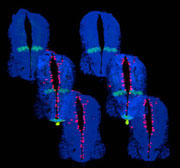
E10.5 spinal cord sections from mice with intact (left series of three) and disrupted (right series of three) sonic hedgehog-proteoglycan interactions: disruption of proteoglycan interactions with sonic hedgehog (Shh, yellow) impairs Shh-dependent proliferation (seen by assessing BrdU incorporation, red), but not normal patterns of Dbx1 (green) expression.
The hedgehog pathway is critical for control of tissue patterning and cell proliferation during development. Proteoglycans are known to influence hedgehog signaling but the mechanisms are little understood. Now, in Nature Neuroscience, Chan et al. reveal that proteoglycan interactions with the mammalian morphogen Sonic hedgehog (Shh) selectively affect proliferation but not patterning responses during neural development.
Many proteins bind to proteoglycans, which makes the defects observed after the loss of a specific proteoglycan difficult to attribute to a particular signaling pathway. Shh contains a proteoglycan-binding domain, and this can be mutated to prevent high-affinity proteoglycan–Shh interactions, without altering the affinity of Shh for its receptor. This mutation allows the Shh–proteoglycan interaction to be specifically isolated. The authors created a mouse containing this mutant Shh (ShhAla) and checked that Shh expression levels were unaffected. ShhAla mice were smaller overall than wild-type littermates, with particular reductions in the size of their brain, spinal cord and eyes. Unlike mice lacking Shh, however, ShhAla animals have no patterning defects, indicating that the Shh–proteoglycan interactions regulate tissue growth. Neural precursor cell proliferation was reduced in the brain and spinal cord, in ShhAla embryos and adult mice.
Precursor cell proliferation is often localized in proliferative zones termed mitogenic niches. Granule cell precursors proliferate extensively in the external granule cell layer (EGL). Using organotypic slice cultures, Chan et al. found that the wild type EGL, but not the ShhAla EGL, provides a mitogenic niche that promotes proliferation of either wild-type or ShhAla granule cell precursors. Immunostaining of Shh in the EGL of ShhAla mice was also reduced. These results indicate the importance of Shh–proteoglycan interactions for localizing Shh to proliferative zones. Shh–proteoglycan interactions also alter intracellular signaling cascades, as demonstrated by the much greater proliferative increase induced in granule cell precursor cultures by Shh than ShhAla.
The expression of Shh-responsive genes was analyzed, with three clusters of genes apparent: one was induced similarly by ShhAla and wild-type, implicating a proteoglycan-independent Shh signaling pathway; a second cluster was induced to a greater extent by ShhAla than wild-type; induction of the third by ShhAla was reduced compared with wild-type. Many of the target genes altered by ShhAla stimulation have been implicated in proliferation and oncogenesis. In a standard assay for Shh activity, there was no effect on the dose–response curve of ShhAla compared with wild-type; however, the ability to bind proteoglycan was shown to be important for the kinetics of signaling, with ShhAla levels in cultured cells declining more rapidly than wild-type Shh after stimulation.
This study shows that Shh–proteoglycan interactions are critical for mitogenic responses to Shh. It ensures the correct localization of Shh, the induction of specific intracellular signaling pathways and altered kinetics of the signaling protein. Proliferation in the absence of differentiation is a hallmark of tumor biology, and the hedgehog pathway may promote oncogenesis when mitosis is stimulated without the required patterning.