Research Highlights
Tumor metastasis: Galectin-1 brings the (cyto)skeletons out of the closet
Functional Glycomics (08 April 2009) | doi:10.1038/fg.2009.16Standfirst
Galectin-1 boosts tumor invasion and metastasis by increasing metalloproteinase expression and cytoskeletal modulation in two types of cancer
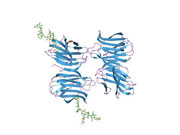
Galectin-1. Source: http://www.ebi.ac.uk/
Galectin-1, a glycan-binding protein with a preference for ligands containing  –galactose, plays a role in a variety of cellular processes, such as growth, adhesion, attachment and extracellular matrix assembly. Overexpression of galectin-1 has also been associated with tumor metastasis, yet the mechanism directly linking galectin-1 to cell motility remains unclear. Writing in Molecular Cancer Research, Wu et al. reveal that galectin-1 promotes metastasis in certain oral and lung cancers by stimulating expression of metalloproteinases and modulating actin cytoskeleton dynamics.
Consistent with other tumor types, the authors detected higher galectin-1 expression in highly invasive oral- and lung-cancer cell lines than in less invasive cells. When galectin-1 expression was reduced in the highly invasive cell lines, their invasive capability was reduced by half in vitro. Conversely, overexpression of galectin-1 in poorly invasive tumor cell lines enhanced invasiveness. This link between galectin-1 expression and invasiveness also held true in vivo; metastasis to the lungs was more frequent in mice injected with oral cancer cells overexpressing galectin-1 than in mice receiving cells that produce very little of the lectin.
Matrix metalloproteinases (MMPs) help drive cell migration by degrading components of the extracellular matrix, including collagen and gelatin. As with galectin-1, high MMP expression in tumors is associated with an elevated risk of metastasis. To investigate whether galectin-1 alters MMP expression, Wu et al. overexpressed the lectin in a poorly invasive oral cancer cell line. They found that galectin-1 increased expression and activity of two types of MMP, whereas inhibiting galectin-1 blocked MMP action. Thus galectin-1 regulation of MMP activity may at least partly explain the role of galectin-1 in cell migration.
Because metastasizing tumor cells must undergo a reorganization of the cytoskeleton to achieve motility, Wu et al. also explored the role of the Rho family of small GTPases. These cytosolic signaling molecules regulate actin polymerization, thereby triggering cytoskeletal rearrangements. Expression of one Rho family member, Cdc42, and the production of filopodia – cellular projections necessary for motility – were increased in oral- and lung-cancer cells overexpressing galectin-1. Likewise, Cdc42 activity and filopodia formation were decreased in tumor cells engineered to produce less galectin-1, implying that galectin-1 increases tumor metastasis by modulating the signaling pathways and downstream cytoskeletal events necessary for cell motility.
Although it remains to be seen exactly how galectin-1 alters Cdc42 activity, this study uncovers an underlying mechanism linking galectin-1 expression and cell migration. Based on this information, galectin-1 warrants further exploration as a molecular tool for blocking tumor metastasis.