Featured Articles
GlcNAcylation: RAREing to go
Functional Glycomics (13 May 2009) | doi:10.1038/fg.2009.17Standfirst
Glycosylation is now implicated in the epigenetic control of transcription, increasing the cellular response to retinoic acid by activation of a histone-modifying nuclear protein.
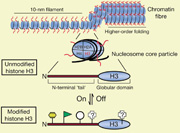
Histone 'tails' project from the chromatin structure and can be modified by acetylation, phosphorylation and methylation. Full figure and legend: Nature 403 41–45 (2000) doi:10.1038/nature07954
In response to retinoic acid (RA) binding, the nuclear retinoic acid receptor (RAR ) binds to RA response elements (RAREs) in the regulatory regions of target genes, activating their transcription. Although some RAR co-regulators are known, the pluripotent effects of RA in cell development suggest that further regulatory mechanisms exist. Kato and colleagues have now identified a new player in RA biology: the authors report in Nature that addition of
  -N-acetylglucosamine (O-GlcNAc) by O-GlcNAc transferase activates a histone-modifying protein, increasing the response to RA and influencing cell lineage determination.
Reversible modifications of histone tails at specific positions form a 'histone code' to define chromatin states and regulate gene expression. One activating modification is the methylation of histone H3 lysine 4 by histone lysine methyl transferase (HKMT) enzymes. Using a mass fingerprinting analysis to find RAR interactants, Kato and colleagues identified MLL5, a protein with known but uncharacterized HKMT activity. Overexpressed MLL5 co-activated RARα in a RARE-luciferase assay. Two different MLL5 complexes were isolated from undifferentiated HL60 cells: a smaller and a larger complex (MLL5-L), which consisted of additional proteins, including O-GlcNAc transferase (OGT). MLL5-L had much greater HKMT activity than the smaller complex, with the target residue shown to be histone H3 lysine 4. The presence of OGT in the large complex suggested that GlcNAcylation might be responsible for the increased HKMT activity. Western blotting confirmed that the complex was GlcNAcylated, and OGT was able to GlcNAcylate MLL5 in vitro. Removal of the monosaccharide by GlcNAcase treatment abolished HKMT activity, as did mutation of MLL5 Thr 440, identified as the GlcNAcylation site.
The donor for GlcNAcylation by OGT is UDP-GlcNAc, derived from extracellular glucose, and its addition potentiated HKMT activity of the MLL5-L complex. High glucose media or a GlcNAcase inhibitor both increased the specific RA-induced differentiation of HL60 cells into granulocytes. In the HL60-R2 cell line, which is resistant to RA-induced differentiation, the GlcNAcase inhibitor restored responses to RA. Untreated HL60-R2 cells had reduced nuclear GlcNAcylation with high GlcNAcase activity in comparison to HL60 cells, and reduced intracellular glucose. Consequently, these cells also had lower levels of GlcNAcylated MLL5. To further investigate the role of GlcNAcylated MLL5 in granulopoiesis the authors monitored RA-induced expression of a major granulopoietic regulator in HL60 cells, C/EBP . Induction of the C/EBP gene by RA was potentiated by the GlcNAcase inhibitor and abrogated by knockdown of MLL5 or OGT. Chromatin immunoprecipitation revealed that the MLL5 complex and RAR were both recruited to the C/EBP gene promoter in response to RA and H3K4 was methylated as a result. Knockdown of MLL5 with shRNA almost halved the capacity of RA to induce granulopoiesis of HL60 cells.
This study is the first to suggest that protein GlcNAcylation by OGT can influence epigenetics and thus fine-tune the response to a transcriptional activator. OGT is known to GlcNAcylate cytosolic proteins, an activity that is regulated by translocation from the nucleus in response to insulin. However, RA did not influence localization of OGT in HL60 cells. It therefore remains to be determined how OGT is regulated in the nucleus to activate MLL5 and induce H3K4 methylation.