Featured Articles
Chondroitin sulfate: Driving bone development
Functional Glycomics (13 May 2009) | doi:10.1038/fg.2009.18Standfirst
Sulfated chondroitin sulfate and heparan sulfate proteoglycans cooperatively influence a signaling pathway necessary for proper bone growth.
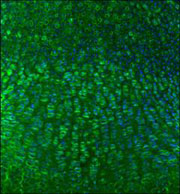
Mouse postnatal day 6 growth plate immunostained for chondroitin-4-sulfate (green) and counter-stained with DAPI (blue)
As a major component of the extracellular matrix and cartilage, chondroitin sulfate proteoglycans (CSPGs) help to maintain tissue and joint structure. Negatively charged sulfate groups allow CSPGs to resist compression and to interact with other proteins in the extracellular milieu. Another structural glycoprotein, heparan sulfate proteoglycan (HSPG), influences the activity of hedgehog signaling proteins in regulation of embryonic development but an equivalent role for CSPGs had not been defined. In Development, Cortes et al. demonstrate for the first time how CSPGs control Indian hedgehog (Ihh) signaling to modulate bone growth and development.
To investigate the role of sulfation in CSPG-mediated signaling and development, the authors used brachymorphic mice, which have a mutation in a gene encoding the enzyme that synthesizes the universal sulfate donor, resulting in a dome-shaped skull and shortened limbs. Biochemical analyses revealed that these mice have undersulfated CSPG, yet normal HSPG sulfation. In situ hybridization and RT-PCR revealed reduced expression of Ihh and Ptch1, a direct transcriptional target of Ihh signaling, in brachymorphic growth plates - the regions at the ends of long bones that continue to grow until adolescence - as compared to wild-type growth plates.
Ihh regulates chondrocyte differentiation, proliferation, and maturation during bone remodeling. Whereas in wild-type mice Ihh is secreted into the extracellular space between chondrocytes, distribution and signaling of this hedgehog protein were reduced in brachymorphic mice. Where Ihh diffusion was restricted in these mice, chondrocyte proliferation was also decreased, indicating that sulfated CSPGs are required for Ihh signaling in the growth plate and proper bone development.
Cortes et al. directly linked sulfation and hedgehog signaling by showing that Ihh specifically binds sulfated, but not unsulfated, CSPGs. Thus the authors propose a model in which CSPGs promote trafficking or protection of Ihh as it diffuses through the extracellular matrix in the developing growth plate, allowing cell-surface HSPGs to then capture Ihh and bring it into proximity with its receptor.
By demonstrating that CSPGs modulate hedgehog signaling, this study highlights the importance of CSPGs in bone development. Further research will reveal whether this function extends to other tissues rich in proteoglycans.