Featured Articles
Ushering perforin
Functional Glycomics (07 July 2011) | doi:10.1038/fg.2011.26Standfirst
Recent work reveals how cytotoxic lymphocytes ensure that a pore-forming glycoprotein gets to its storage site without causing cellular damage.
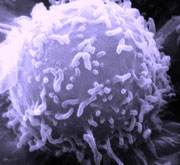
Scanning electron microscope image of a human lymphocyte.
Cytotoxic lymphocytes can promote the killing of infected or transformed cells by delivering perforin, a glycoprotein that can polymerize and assemble a pore on the target cell's membrane. Perforin is stored in secretory granules, whose acidic, lysosome-like pH keeps it inactive. Once perforin is released from the granules to reach the target cell, its ability to form a pore is triggered as it encounters an environment with a neutral pH and high extracellular Ca2+ concentrations. Such conditions are also found in the endoplasmic reticulum (ER) compartment, raising the question of how cytotoxic lymphocytes avoid self-damage from perforin before it reaches its storage site. Now work from Ilia Voskoboinik and colleagues published in the journal Immunity reveals how cells ensure that perforin gets trafficked efficiently from the ER to the secretory granules.
The authors initially found that the 12 C-terminal residues are not required for function in vitro; however, when transfected into cells, the C-tail deletion mutant caused autolysis. Additional mutation of residues required for binding of perforin to target cell membrane or for oligomerization could suppress the toxicity of the C-tail deletion. The cytotoxic effect could be reproduced with the single mutation of the final C-terminal residue of perforin, a conserved tryptophan. The authors followed the intracellular localization of wild-type and mutant perforin, by immunofluorescence and analysis of glycosylation, and observed that the C-terminal tail promotes rapid export of perforin from the ER into the trans-Golgi network, indicating that the delayed exit from the ER of the mutants was cytotoxic. The authors tested this interpretation using two independent lines of evidence. Disrupting protein traffic from the ER to the Golgi compartment with brefeldin A rendered wild-type perforin toxic to the transfected cells; an engineered perforin bearing an ER retention motif also had a toxic phenotype.
The authors next examined the role of perforin's N-linked glycosylation. Mutation of the two identified consensus sites affected the lytic function of perforin on target cells, as it reduced its trafficking from the trans-Golgi network to lysosomes and granules. Engineering a novel glycosylation site into perforin restored the cytotoxic activity toward target cells. Importantly, lack of perforin glycosylation neither affected exit from the ER nor caused any toxicity to the perforin-expressing cells.
How exactly perforin gets exported from the ER to the Golgi, and how it can cause toxicity in the ER, remain to be determined, but this study uncovers the features in perforin that allows it to be trafficked quickly and that are essential for the viability and function of cytotoxic lymphocytes.